Chris Detzel (00:00)
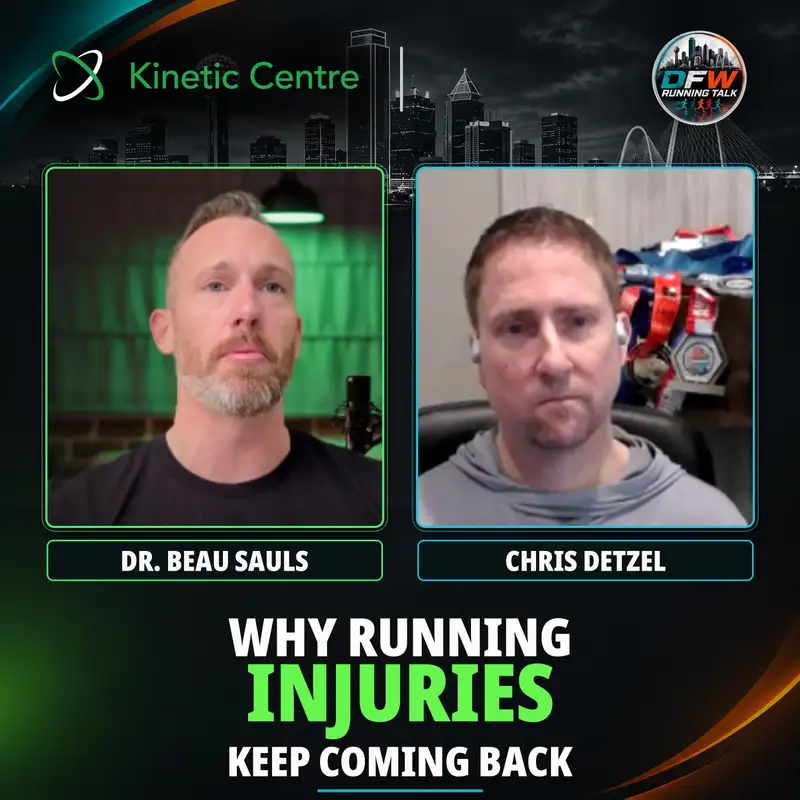
All right, welcome to another DFW running talk. I'm Chris Detzel. And today we know that running injuries can be incredibly frustrating. So you put months into your training, you're getting stronger, your fitness is improving, and then something starts to hurt. So maybe it's your Achilles, maybe it's your knee, maybe it's your hip or foot. You take some time off, things start feeling better, as we always do, and then you get back to running, and then the problem comes right back. Why does that happen?
Is that is it's how we're running? Is it you know how we're training, or is it something completely different? So today on DFW Running Talk, I'm joined by Dr. Bo Sulz. He's the CEO of Kinetic Center. So Bo Bo specializes in biomechanics, functional movement, and helping athletes understand how their bodies move. So he's worked with ⁓ professional athletes, but today I want to focus more on everyday runners.
And the person training for first their first 5K or the Boston Marathon or qualifier or just trying to keep running well into their 50s, 60s, and beyond. Look, I'm 51, so I can kind of relay. So we're going to talk to them about running mechanics, recurrent injuries, new technology, recovery, and what runners can actually do to stay healthy and perform better. So Bo, welcome to DF to run DFW running talk. How are you?
Dr. Beau Sauls (01:24)
I'm great. Thanks for having me, Chris. ⁓ I'm excited to talk about this. It's something I was a basketball player long term. Running's been a huge part of my training. Distance, endurance, ⁓ sprint, explosive, plio. So it's been a big focus for the clinics and ⁓ I'm excited to come talk to you. So thank you for having me.
Chris Detzel (01:46)
Yeah, so tell me a little bit about your relationship with sports. So you mentioned you did some stuff. Can you go a little bit ⁓ deeper and athletics as you grew up?
Dr. Beau Sauls (01:55)
Sure. It's definitely a love-hate relationship, is what I would say. ⁓ I have been chronic injuries due to overload, ⁓ poor nutrition, ⁓ bad rest, bad recovery, ⁓ overlo overdoing it mentally. ⁓ it's been a it's been a lot of injuries that have created a lot of problems for me. ⁓ I think the the biggest thing that I I've dealt with is exhaustions to joint complexes.
And then that causes things to become unstable just from overload, which is a common problem ⁓ for runners and and endurance athletes all around. And so being able to identify before things break down and become a problem was a big focus of mine because I got hurt so much. It was basketball. ⁓ and I I had a little bit of low level ball that I played, and then I got out of that through injuries, and then I moved into more health care after.
multiple tears and fractures and so then ⁓ after spending time in healthcare it was more on the side of I still want to be able to perform, run, lift weights and play basketball myself.
Chris Detzel (03:07)
So were you someone who like naturally understood the importance of movement or did you did that kind of come later?
Dr. Beau Sauls (03:16)
Yeah, well I don't think it was ⁓ it was natural. I guess it was natural in in the fact that ⁓ you learn through mistakes. ⁓ and that was probably how I figured out that I'm doing the wrong thing. I ended up ⁓ fracturing my right ankle four times. So ⁓ I am not the type of person to ⁓ get hurt and then lay down. I definitely got hurt, rehabbed as fast as I could.
got right back into the sport and re-injure and re-injure and re-injure. And then that's created this whole chain of mechanical problems at my body that ended up tearing up my opposite knee, then went to my hip, then went to my lumbar. And I'm just dealing with injury after injury after injury. But it became understanding that it was the overdoing it in the mental aspect, but poor nutrition recovery and then not being stable and understanding my mechanics was also the the part that all kind of fits together for the whole picture.
Chris Detzel (04:14)
So did you did you kinda think like, hey, you know, I've been doing these things, what you know, was there kind of a a thinking of there's gotta be a better way to to do this, you know, to treat it.
Dr. Beau Sauls (04:24)
For sure. I think that ⁓ yeah, as and you you know, I I went through a lot of healthcare myself. I mean, when you're an athlete and you're getting injured, that you're trying to get back on the court or into on the field or whatever you're doing as fast as possible. So you're gonna get all the treatments. That means that you'll go through ⁓ medication, injections, PT, Cairo, you have tons of imaging, then you go STEM, different lasers and red lights, and I mean
Massage therapy, I we've been we go through everything, ICU, ⁓ dry needling, we can just keep going and going and going. But my point is that you go through it as an athlete and you might feel some symptomatic change at the moment, but you notice that function doesn't change. And when your function's not changing, it doesn't mean that you can perform. So yeah, I I noticed that it the symptom feels better right now, but then I get up and I go, and as soon as I go, I don't have any any movement of my leg, and then I s it ends up feeling the same problem again.
Chris Detzel (05:22)
So you know, you were involved in like a movement rehabilitation before becoming a chiropractor. What did that early experience teach you that you know you still kind of use with patients today?
Dr. Beau Sauls (05:33)
That's a that's a very good question. ⁓ it's a foundation to to how I think, I believe. ⁓ that's probably more where I got developed, was more in that area versus sports. I mean, everybody can play sports and get injured and like I think I was talking to you earlier, it's ⁓ we can all run, we can all run a half marathon on a marathon, we can train for it and do it, and we can go perform it. But the understanding of the physiology behind it doesn't necessarily come with that. You learn about yourself and you learn about things that you need to do.
But there's parts and mechanics and things that it's helpful to have something that helps you identify what's changing before you can feel it. And then you don't really want to have to feel that. So my development comes more from working in ⁓ acute pain clinics that utilize myofascial therapy and rehab. They're a very large company. ⁓ and I got to work under multiple doctors. So and I worked we worked in an active community, worked with r all running groups, CrossFits, and all sorts of different sports and of course sports teams. And the doctor would perform the myofascial therapy.
And then my job was to be the one that helped educate the patient on the rehab portion and how they were gonna get better. And this company averaged 3.2 visits for pain, specifically pain, ⁓ which is great. That was a it's that's an awesome thing to be able to do. You need to be able to get out of the symptoms so you can perform. So I think that's a a big piece. And then understanding the process of taking an acute injury in three visits back to no pain and moving, maybe not complete function, but moving again without pain.
Chris Detzel (06:46)
Yeah.
Dr. Beau Sauls (07:01)
That's huge. You have to have that as the part beginning of a process. You can't not treat the symptom and take care of the symptom. You can't just take care of the cause. But you have to do both. So spending time under multiple doctors, I got to see what doctors were doing well and what doctors were not doing so well. And then see patient improvement when those same patients had the same rehab, or excuse me, different patients had the same rehab. Why did one patient get better and the other one didn't?
Chris Detzel (07:15)
Yeah.
different patients had the same rehab. Why did one patient get better and the other one didn't? Yeah. And then I can see the difference in the process to how people fasciitis and focus tinniditis, ⁓ how much is it great toes, big toe issues, issues, the stomach.
Dr. Beau Sauls (07:29)
And then I could see the difference of the process to how people were getting better with plantar fasciitis, Achilles tendonitis, ⁓ haluses rigidus, the great toe, the big toe issues, knee issues, and just so many. But I got to see the process of success versus not success, even though the rehab's the same. So I learned like how educating the patient on what they're doing and why they're doing it was more important than just doing toe crunches or ankle stability or hip activation. Now
After I accumulated that, I got to train under one guy for about two years who taught me how to follow pathways, analyze mechanics, understand how you apply physiology to sports and movement, meaning what tissues do what, how do these nerves do? Remember the layout of all these tissues. And then he helped me lay fastel slings through it. And then it taught me full macro systems and how everything moves. That all happened.
Chris Detzel (08:23)
And then he taught me like fast little slips through it. Yeah.
Dr. Beau Sauls (08:27)
before I went to school. So it's thousands of patient visits. And then I went and I put the physiology, anatomy, and all the microbiology. Because micro is not as it helps and that's I have it as a foundation, but that's not what I'm utilizing with a patient. So it helped me get all the sciences and understand the sciences through more of an application process after spending time with those patients.
Chris Detzel (08:35)
Base that once
Lasting.
Dr. Beau Sauls (09:36)
I lost you, Chris.