Chris Detzel (00:00.652)
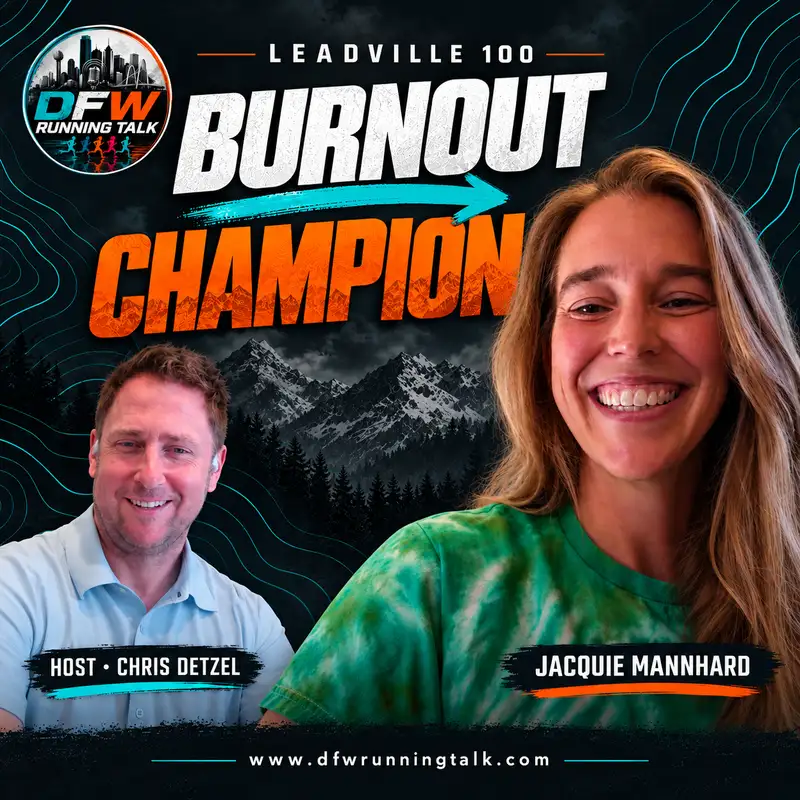
All right, welcome to another DFW running talk. I'm Chris Detzel, and today's special guest is Jackie Manhart. Jackie, how are you?
Jacquie Mannhard (00:08.662)
I'm doing great, Chris. Thank you so much for having me on the show.
Chris Detzel (00:12.802)
Thanks for coming. And this is slightly different for our audience, and I'll tell everybody why, real quick. Is so my wife and I went to Iceland on a trip with a company called Fit for Adventure. And I met this couple, Mary, Ann, which this is kind of telling you where this is going. And and they were we were talking and they were telling me about this daughter that they had that was running in Leadville, the Leadville 100, as a matter of fact. And they told me that
In twenty twenty three that you won it, outright, you know, women, all the women stuff. And and that you were actually running it at the time as we were talking, so we we didn't know, but you'd get second place this year, which a little one hundred is really hard. So congratulations.
Jacquie Mannhard (01:00.142)
Yes, thank you, thank you. My body would agree with you. It's very hard.
Chris Detzel (01:04.462)
Well, you know, I've I've done the Leadville heavy half. my wife's done the marathon there. And you know, I just know and and we've done some stuff. you know, we did this twenty-four or this six-day trip. It was 120 miles and 20,000 feet again. a couple of years ago they would do it, I forgot what it was called, but anyways the point is like I know how hard some of that course is. I I have not done the hundred. And I've had a lot of friends that have attempted to to try to finish.
Jacquie Mannhard (01:28.354)
Yeah.
Chris Detzel (01:33.972)
Or have finished at but the Leadville one hundred is extremely hard and and and and for you to get first and second place pretty amazing.
Jacquie Mannhard (01:42.622)
Yeah, thank you. Thank you. It was a it was a great day out there. just real quick to set the record straight,
Jacquie Mannhard (02:18.069)
Yeah, I mean a good starting point is talking about my parents. you met them, so you know how how cool and kind and adventurous they are. But my mom is like a total legend in my eyes, of course, of running. She's in her mid-sixties and she's still training for races. she's doing triathlons and marathons and half marathons. and more importantly than all that, she's doing it really joyfully and injury-free. Like she just absolutely loves.
to be running, biking, swimming, hiking. so she's a she's a big inspiration to me. So when I when I was a kid, she was into marathon and triathlon. My dad was doing some at that time as well. He's he's awesome as well.
But I grew up, I grew up in this context of like, well, it's Sunday morning, we're gonna pile into the minivan, all five of us kids, and we're gonna go drop off water bottles for mom on her long run. And so I truly thought like this is a normal thing that families do. So I would say like the seeds of distance running were kind of planted in my mind from an early age, just from having this really
Chris Detzel (03:06.562)
He's awesome as well.
Jacquie Mannhard (03:33.578)
Badass mom doing these things in the late 80s and early 90s when that was pretty rogue to be coming back to sport to sport postpartum. you know, I'm sure she faced a lot of sexism and a lot of criticism in doing that. And it was just her place of joy. So she continued down that road even now, many decades later.
Chris Detzel (03:44.643)
Yeah.
Jacquie Mannhard (03:58.178)
So I would say a lot of those early, the early ideas for me about running came from sort of watching her do that through my childhood.
Chris Detzel (03:58.351)
Yeah, it's pretty awesome.
Chris Detzel (04:07.394)
I think that's pretty cool to have an inspiration, you know, your mom as an inspiration because like I have a son, he's sixteen now, and I remember when he was four and five and you know, we did a lot of running and so I would just take him and sign him up, especially whenever he's six or seven, like you know, whenever he's younger we do like a mile race or something. But then when I get a little bit older, I mean I just sign him up and even today I'll do that. He's not a runner anymore.
My hope is is that he's at the very least inspired by us a little bit, you know, and and more of, hey, I know what to go do if I, you know, need to lose you know, if I'm stressed out when he gets older or if I need to lose some weight or I need to I know how to get into exercising and and running is a big part of it. So I love that. That's really cool that you kind of follow that in some ways.
Jacquie Mannhard (04:58.355)
Yeah, I think the the kids are watching, even if they're not necessarily runners at the moment, they're picking up on the the macro level themes about how to set a goal and how to achieve something and how to push yourself. I think they're getting all of that through osmosis just from having a parent in running.
Chris Detzel (05:16.768)
I mean, he comes to everything. I mean, if if he's here, he's signed up. He knows. So but so how d so your mom was an inspiration and then did you kind of get into it early from, you know, like middle school, high school? What's
Jacquie Mannhard (05:20.737)
Yeah.
Jacquie Mannhard (05:32.31)
Yeah, I I was not running at an early age. And actually I would credit a lot of my longevity to that fact. When I was a kid, I was primarily a swimmer and my siblings as well. We were all swimming year-round and my parents had us involved in all different sports. Like we were playing soccer, volleyball, tennis, karate, dancing, and I think that that foundation of like exploring a whole bunch of different things is so important for kids early in sport.
Chris Detzel (05:54.254)
Keep on busy.
Jacquie Mannhard (06:02.305)
So I as a kid, I mean, I think I ran a couple seasons of track and my mom helped to coach, but it was not my my main thing by any means. even in high school, I joined the cross country team and I had some like early success with the cross-country team, but I definitely would have described myself as a swimmer in high school. I was swimming year-round and then taking a break to run cross country in fall. So it wasn't until college when I decided to.
Chris Detzel (06:24.333)
Okay.
Jacquie Mannhard (06:32.207)
to walk on to the cross country and track team at Truman State University in Missouri, that it wasn't until college that I would have really described myself as a runner.
Chris Detzel (06:42.349)
So what did that look like before c like? I mean, you just get on were you doing any running at all or what's
Jacquie Mannhard (06:48.819)
Yes. Yes. I was still doing some running. I mean I would run in the cross country season and
Chris Detzel (06:54.995)
Okay. So you did that in high school but you w didn't consider yourself as a runner.
Jacquie Mannhard (06:58.953)
Yeah, I would say I would just have described myself primarily as a swimmer.
And then, you know, I would train up for cross country season. I would start training in the summers. I would I have memories of waking up before school and running with my mom and dad just because they were already doing that. So it's like, come on, here we go. So I was I was running even during the swim season, but in a very like gentle, unstructured way. I didn't have any rigorous training program. But, you know, as a kid, especially, you start to see how the formula works, like the more.
Chris Detzel (07:17.933)
That's great.
Chris Detzel (07:24.886)
Okay.
Jacquie Mannhard (07:32.555)
you put in the more you get out. So I quickly learned that if I do a little training in the off season, I show up to cross-country quite fit, can run quite fast. So it led to you know figuring that out in high school.
Chris Detzel (07:48.172)
I think in high school it's it's funny because a lot of kids won't train over the summer or those things, you know, like I remember I ran cross country as well and you know my parents weren't runners, they were not they didn't do anything like that. So, you know, I didn't really have that info. So I didn't know a lot of stuff. And so I just show up probably a little bit out of shape during, you know, the start of cross country. And so I'm I'm sure you just had an advantage over most of the kids already just by being in shape.
Jacquie Mannhard (08:15.339)
Yeah. Probably so. And I mean, I definitely had a huge aerobic engine just from being a swimmer. so even if you're not the fastest runner on day one of cross-country season, you have this kind of monster foundation that once you start turning over the legs, you have the aerobic system to support it. So I do think, you know, the swimming helped to support the running in the high school years for sure.
Chris Detzel (08:17.053)
You know. I mean, so that's one.
Chris Detzel (08:22.882)
Yeah.
Chris Detzel (08:36.333)
Yeah, that makes
Chris Detzel (08:41.473)
Hundred percent. I mean, so you get get to college and you just try out and get on.
Jacquie Mannhard (08:47.861)
Yeah, I went to a Division II school in Missouri. And so, you know, I wrote to the coach and asked if I could join the team. And he said, sure, come on. Yeah, I, you know, I didn't have any scholarship money at that time for running. I was just having you just academically. And so
I walked onto the team and had some success pretty immediately. Like by the time I finished at Truman State, I was on a full scholarship. So again, I think it's because I had still so much uncovered potential. that there was a lot, there was a lot to dig into in those college years. So I started off just as a walk-on and then ended with a pretty successful.
Collegiate career like running All-American and track and cross-country at the national meets. So it was a pretty cool chapter.
Chris Detzel (09:39.745)
I wanna hear just a few stories. So think about that as kind of get this question out. is one is what what's the distance for the cross country piece for you back then?
Jacquie Mannhard (09:50.599)
Women usually run five K through the season and then run six K at the regional and national meet.
Chris Detzel (09:56.94)
All right. And so, your first year was it was it different, tough, or was it hey, you know, this I mean I mean cross country's hard anyways, but I'm sure but what was that like?
Jacquie Mannhard (10:09.357)
Cross country is so hard. I think cross country is the absolute hardest. it was hard for me, I think, because my body was still quite immature to that level of training. you know, I can remember showing up to preseason workouts my freshman year and lifting weights kind of for the first time. And then, you know, the next day, like I couldn't lift my arms to shampoo my hair. I was so sore. I was so wrecked from the training load. So like it was hard and I was not
Chris Detzel (10:31.238)
Exactly.
Jacquie Mannhard (10:38.579)
A star from the get-go at all. I think you know you really see the progression through college as people's bodies kind of adapt and harden off to the training load. You just become, you know, hopefully more muscular and more durable, and that leads to faster results. But certainly I was, I was wrecked the my first season as a collegiate runner.
Chris Detzel (11:02.572)
And did you get into track immediately as well, or was it just cross country?
Jacquie Mannhard (11:06.367)
Yeah, so one thing I did not realize is that the the cross country team becomes the distance team for the track season. So we all we all ran cross country and then in fact we all ran indoor track, like 3K and 5K for the indoor season, and then we transitioned to the outdoor season with some of the women would would go down to like the 1500 and the 3K and people that were distance beasts like me would go like 5K, 10K on the track.
Chris Detzel (11:12.704)
of course.
Jacquie Mannhard (11:36.271)
So we ran three seasons, which was it was a lot. It was destructive in many ways and unhealthy in many ways, but that is what we did.
Chris Detzel (11:49.891)
lot of people do it, you know, and so if you kinda look at getting better and better over time during college, what what kind of 'cause you mentioned you you got all American. How did that happen and what did that look like? I'm curious.
Jacquie Mannhard (11:51.5)
Yeah.
Jacquie Mannhard (12:06.165)
you know, I have to say when I think back on the college years, I have very unclear feelings and reflections about all of it. like yes, you can look on paper and say, wow, this person had a successful collegiate running career.
But at the same time, I was a very, very unhealthy and injured and burnt out athlete. So when I think back on it, I'm grateful that I had this very challenging experience to learn from and grow through. I'm really, really grateful for the women and the men that were my teammates in those years. Like those friendships are very dear to me, and I still have so much love and respect for those teammates that, you know, we were together through those challenging years.
But the NCAA then and now is still actually really, really problematic when it comes to churning out healthy runners. I recently saw an article, this was published in 2024, that was showing that something between 50 and 90 percent of NCAA runners are suffering from eating disorders. And so, like, this is a huge red flag. Like, these are not athletes that are going to be able to compete and
Train at their full potential. So I feel like when when I think back on my own college experience, like I was very underweight. I was very unhealthy. I suffered all the cascade of injuries that come along with that. So it's a bit of a Jekyll Hyde sort of experience. Like, yes, there was success, and there's there's trophies and there's medals, rah-rah.
Chris Detzel (13:43.534)
That's true.
Jacquie Mannhard (13:50.274)
And you can flip that over and see like, whoa, I had tons of bone stress injuries. My body weight was so low. It took me a long time to recover from my years as a collegiate runner as well.
Chris Detzel (14:05.016)
Well that that's interesting then. So I would love to dive in a little bit into that then, that piece, if you're interested in talking about some of that. Okay, good.
Jacquie Mannhard (14:11.627)
Definitely. I love talking about this because I am so, I cannot wait for the day when we can stop having this conversation. It's still so pervasive in collegiate running, but also running in general. I cannot wait for the day when we have all like figured out the data showing that you have to fuel your work and strong bodies are healthy bodies, and we can stop having this conversation about underfueling.
Chris Detzel (14:38.85)
I feel like you know, with today and and obviously what you're saying is like, you know, it's just not ha it's still not happening, but you know, there's a lot of science that goes into, you know, fueling your body is very important, especially when running. Like, I mean, if you're running a marathon, half hundred, I don't know, whatever it is, you've gotta eat, you've got to drink, you've gotta, you know, fuel proper and and obviously during training is you know, ninety-nine percent of what you're doing anyways and racing is what, one or two percent at best. And so
Jacquie Mannhard (14:58.317)
Mm-hmm.
Jacquie Mannhard (15:04.429)
Mm-hmm.
Chris Detzel (15:08.194)
you've gotta do you've gotta eat the right things kind of throughout your breakfast, lunch, dinner, snacks, et cetera. Not to say you shouldn't, you know, eat nice or good, but you know, I do think that I mean I think it's just science, you know? But but you c I mean obviously you're you still see and and kind of when you were in college, maybe even now, but something a little different. So tell me about that. You know, like the just the pressure that's put on you, the
Jacquie Mannhard (15:22.379)
Yeah.
Chris Detzel (15:38.328)
Things that maybe a coach might say that you're you kinda red flags and things like
Jacquie Mannhard (15:41.346)
Yeah. Mm-hmm.
Yeah, I think part of the problem thinking back to college, and I don't think this is specific to my team or my coach, I don't think it is a fault of them. I think it is a problem with the culture and distance running that existed then then and it still is existing now. But you're in this silo with your teammates being your friends, you spend tons of time together, you share every meal together, you travel together to competitions on the weekend. And so as soon as there is like signs of disorder.
Eating, it really spreads like wildfire. You're surrounded by other people who are also eating in disordered ways or engaging with food in disordered ways. And so that shifts what you feel is normal. The other thing that is very seductive is that for a while, when you lose weight, you run really fast. For a while, the formula, yeah, for for a minute, the formula works really well.
Chris Detzel (16:36.022)
That's true. I felt that last year.
Jacquie Mannhard (16:42.665)
until you're completely injured and it doesn't work at all. So I think also back when I was in college, I mean this was 20 years ago now, the coaches we had we would have body fat testing, we would have all these things that just the coaches wanted us to be thinner.
And I think now there's just so much evidence to support that a fueled athlete is a faster athlete, that if there are still coaches at the collegiate level, at any level, who think that a skeletal athlete is gonna outperform someone who's who's fueled and strong and muscular, they're simply wrong.
I I feel hopeful that the that this culture will start to change and the tides will turn on it because what I see happening now is that my generation of athletes who lived through this and potentially had running careers ruined or cut short by this, we are now.
Parents of athletes. We are now coaches. We are now in positions of decision making. Even one of my former teammates, she is like writing the book on women's bodies and sports. She's a researcher. So I feel hopeful that the culture is shifting. but it's still so disheartening for me to see that the NCAA sort of treats athletes as like these are the four most important years of your running career. it's not, there's there's a reason.
why the NCAA records are not the world records. Like when you are 20 years old, you are not at your full potential. And so to treat an athlete like that's the epitome of their career is wrong and it's doing a disservice to the athlete and to the the running world as a whole.
Chris Detzel (18:19.275)
I agree with that.
Chris Detzel (18:29.55)
It's a great message and I and I appreciate you kinda bringing that up. and I I think it's important to talk about
Jacquie Mannhard (18:33.621)
Yeah, I'm sorry, you you got me high on my soapbox with that one. I feel so passionately about that.
Chris Detzel (18:40.332)
No, that I mean, that's what this is for is to kind of spread the look we're all running, you know, people that listen to this podcast are runners. So, you know, and I think the message is necessary. And I think that, you know, i if if we're not fueling properly and we're always trying to lose weight, like you said, I mean, you know, losing some weight is it's it's it's seduct seductive a little bit, right? You know, because you get a little bit faster.
Jacquie Mannhard (18:47.915)
Yeah.
Chris Detzel (19:09.592)
Then what happens is you start getting fracture, you know, hairline fractures and other things that, you know, last a long time and then, you know, it's just giv it's it's just bad you know, what do you call it? just habits that we don't need to get into and messes with our mind and and things like that. So I appreciate you bringing that up and I think that's very so let's talk about after college.
Jacquie Mannhard (19:12.225)
Yeah. Mm-hmm.
Jacquie Mannhard (19:37.323)
Yeah.
Chris Detzel (19:39.71)
And you know, and I would love to kind of hear a little bit about, you know, what happened after college and then, you know, and then you know, did you start eating better? Did you you know, let's talk about that, you know, a little bit and then and kind of where you are today.
Jacquie Mannhard (19:53.612)
Yeah.
Yeah, after college I needed to step away from running in a big way just to I was so burnt out and I my body was so unhealthy it wasn't sustainable at all. the
A couple of things changed for me at that time was sort of leaving the team culture. You're no longer a part of this collegiate team. Yeah, it is tough. But I was really lucky at that time. I had this amazing, handsome muscular boyfriend who's now my amazing handsome muscular husband, actually. But spending more time with him and seeing how he was eating as an athlete, like,
Chris Detzel (20:16.11)
It's gonna tough.
Jacquie Mannhard (20:37.555)
Bro is scrambling up an entire dozen eggs for breakfast. You know, that was kind of a light bulb for me, like, I'm my body's working just as hard and I'm fueling with with rice puffs, you know?
Chris Detzel (20:41.155)
Yeah.
Jacquie Mannhard (20:50.857)
And so spending more time with him and realizing, like, okay, that's that's different for sure. the other thing that happened at that time is that he and I we lived together in a housing co-op, which this is this is gonna sound really weird, but it's a beautiful place where it was a big home shared with 13 people, and we would
Chris Detzel (20:51.342)
Exactly.
Jacquie Mannhard (21:13.463)
Purchase our food collectively and then prepare dinner every night of the week and share dinner as a community. And so some really important things happened for me in that chapter, which is that I had to relinquish control of what food was being purchased and how the food was being prepared. And additionally, you had to eat in the presence of normal people. And if you were still perpetuating, if I was still perpetuating like these weird
Chris Detzel (21:38.722)
No secrets.
Jacquie Mannhard (21:43.37)
Eating disordered habits, it finally looked weird because I wasn't surrounded by other athletes that were suffering from disordered eating. So, you know, I think mental health problems and disordered eating, it really thrives in secrecy. And so by living in this community context and being in relationship with my boyfriend at the time, my husband now, it like just shone a light on it to say, like, girl, you are off track.
So taking that distance from sport and then adding sort of these different perspectives into my life really helped me to get out of that funk.
Chris Detzel (22:20.79)
Well, it's kind of interesting that you saw that's ins inside your I mean it's one, I think peer pressure is good and bad and it depends on the peer pressure, right? I mean the peer pressure that you were dealing with at at school, you know, you had the same kind of people running and things like that doing something similar. So you were doing that and maybe you knew it wasn't normal, maybe you thought it was slightly normal, who knows? But then normal I say normal peop people that just eat normally, if you will.
Jacquie Mannhard (22:30.647)
Yeah, true.
Jacquie Mannhard (22:47.521)
Yeah.
Chris Detzel (22:50.176)
Seeing that and and recognizing that was probab that's kind of a I mean, a of people might not make man, I can't do this or but
Jacquie Mannhard (22:52.726)
Yeah.
Jacquie Mannhard (22:57.429)
Yes, yes, I remember you know, we would buy because we would buy in bulk because there were so many of us, there was this huge piece of cheese. Like imagine a big bulk cheese, amazing organic, sharp cheddar. And my housemate coming home and just taking a huge knife and cutting this thick slice of wonderful cheese and eating that. And just I remember watching her like, wow.
You can do that. That's a thing you can do. Because I, when I was living alone, I was buying cheese individually wrapped because I knew if I had a big chunk, I would be tempted to eat the whole thing. I was so hungry. And so it just like reset for my brain and my body what was a normal relationship with food.
Chris Detzel (23:25.365)
yeah.
Chris Detzel (23:44.847)
So interesting. I you know, I I don't really deal with that issue, so never really have and and I know a lot of people do. And so how did I mean, did did you just like did that kind of start normalizing, you know, just eat you like, you what, maybe I should eat a piece of steak or two or three or whatever or whatever. You know, is that
Jacquie Mannhard (24:02.879)
Yeah. Yeah. And just also being in a context of people like when you're in collegiate running, that's your world and you care about it so deeply. And then being in a close community of people that couldn't care less about running. And it was really, really helpful to to again recalibrate like, yeah, it's just not that serious. This stuff actually doesn't matter. And if it's actually harming you, if it's taking away your joy, you are off track.
Chris Detzel (24:18.03)
Yeah.
Jacquie Mannhard (24:32.907)
So it was a very helpful calib recalibration for me.
Chris Detzel (24:38.178)
You know, my wife said something to me. So my wife's been running marathons for a long time and she's done Boston thirteen times in a row and you know, all the other majors except for one of them or whatever. But and she'd been doing it for twenty years. And recently she decided, you know what, I don't want to run marathons anymore. I'm I'm now gonna be instead of a runner that lifts weights, I wanna be a weightlifter that runs every now and then. You know? And so for the last certainly for the year, but
Jacquie Mannhard (25:02.881)
Nice.
Chris Detzel (25:07.094)
you know, two or three years she you know, she kind of struggled with her running piece. Should I, you know, I'm not loving the the training anymore and things like that. And so she stopped she just still runs twenty five to thirty miles a week. So it's not like she stopped running, you know, but she spends three, four, five days a week in the weight room. She has a coach, all these things. And, you know, she and the thing that kind of got me was, you know, I don't want to be seen I don't want to look back and think,
Jacquie Mannhard (25:24.758)
Yeah.
Chris Detzel (25:37.379)
That's all I'm known for is being a runner, a marathon runner. You know, like like you said, it's not that serious. We love it and we get into it and I think it's good. You know, we have to have some passions. But I mean, I have a passion of running. I run a lot and you know, I have a podcast about running. So we love to talk about it. But it doesn't define who you are, you know. It doesn't have to, anyways. I mean, like you have kids that are doing sports, you have a husband, you have all kinds of things going on and you run.
Jacquie Mannhard (25:44.409)
Exactly. Yeah.
Jacquie Mannhard (25:56.142)
That's right. That's right. Mm-hmm.
Jacquie Mannhard (26:06.635)
Yeah. Yeah. Yeah. I feel I feel happy to say that in this chapter of my life, like running is the running is the pathway that like makes me who I am, but running is not who I am. and there's something really liberating in arriving to that place as an athlete and as a human.
Chris Detzel (26:07.182)
And you win races sometimes, so you know, that's good. So
Chris Detzel (26:28.76)
You know, I started running and and I love that. I mean this I I'm I'm loving where this conversation's going. but I remember I started running because I get a divorce several years ago, like twelve, thirteen years ago, and my brother, he goes, Hey man, you need to do something. You know, you're stressed out, you've gained a lot of weight, you know, you need to exercise 'cause I wanted to do any exercising, you know. So I mean, healthy exercising is good if you you know, you need to lose weight. And so I just start because I knew, you know, I used to run in high school and stuff and I thought
Jacquie Mannhard (26:51.169)
Yeah.
Chris Detzel (26:58.488)
Well, that's one way to do it. I should do it. And I started doing it and got better and better and and lost some weight. But the point was, you know, healthy exercise is good and that's kinda how I took it. And I think that, you know, I haven't stopped running since. certainly need to start lifting weights and things, but so I guess the point is like, you know, doing it healthy, you know, kind of focusing it on something that isn't I think exercise in general should be a really good thing, but that's not who you are.
That's really kind of the point. So all right, let's keep going. Sorry, you know, I digress a little, but you you kind of living in this house with 13 people, your boyfriend at the time that's super muscular, handsome, etc., is eating
Jacquie Mannhard (27:27.884)
Yeah.
Jacquie Mannhard (27:35.019)
No, great.
Jacquie Mannhard (27:43.149)
Just like a strong athlete. Yeah, he was a he's amazing.
Chris Detzel (27:48.007)
And so I'm glad you're still saying that, you know. That's good. 15 years later, a couple of kids. We'll we'll get into some of that in a minute. but so t tell me more about that, you know, you
Jacquie Mannhard (27:50.483)
Yeah, yeah, yeah. Fifteen years later.
Jacquie Mannhard (28:02.155)
Yeah. it was mostly just kind of an adventure chapter for us then. We did a lot of like mountaineering and epic bike riding and and
you know, touring around on Nordic skis. So that was a pretty fun chapter and also just expanding ways of exploring and and adventuring besides running on a track or road running. That's also when I kind of started dipping my toe into trail running. it's hard to avoid when you live in a place like Boulder and you have this like amazing trail system right outside your door. So that was very liberating to kind of break out of that very rigid, like pace based
Heart rate-based training and just be like, we're out here exploring our objective today. No one knows the distance or the pace, but we're gonna try to get to that summit, or we're gonna try to get to the other end of town on the trail system. So that was kind of a fun new chapter for me, just getting more adventurous and exploring. So
We lived in Boulder then until we were married and then we lived in Barcelona. And that's when I kind of picked back up with a little bit of road racing in that chapter. I also worked as a running tour guide, which was pretty fun. Like touring people around the old city of Barcelona on foot was super, super fun. So yeah, I guess after college I kind of had all these different chapters of expanding my definition of what it meant to be a runner and to be running.
Chris Detzel (29:31.544)
That's pretty cool. Tell me more about Barcelona and the the the guiding guided tours and th was it like trail running or hiking or both or what would all look?
Jacquie Mannhard (29:41.726)
most of it was like urban trail running. I I honestly still think it's the best way to explore a city is like wake up really early before the people and before the traffic and just set out on foot. and I mean Barcelona and the old city, it's so magical. Like these little these little alleyways and tiny plazas. And so
Yeah, I would meet people and and you would tour around through the old city. There's also a cool trail system in Barcelona. So if people wanted to do trails, we would kind of get to the edge of town and and check out the trail system. But mostly it was like in the the urban heart of the old city. It was really cool.
Chris Detzel (30:19.49)
Now what'd your husband do?
Jacquie Mannhard (30:21.343)
Yeah, he works in clean tech. He works for a startup that's involved with electric vehicle managed charging. in Barcelona he was studying he was doing his MBA, his business degree. Yeah, so that's that's the reason we went there. He was enrolled in this program and then I was working as a tour guide and teaching English and yeah, having having a great time.
Chris Detzel (30:28.28)
But what was he doing in Barcelona though? Sorry.
Chris Detzel (30:34.325)
Okay. Got it.
Chris Detzel (30:45.536)
Yeah, that's how long were you all there for? Okay. Cool. That well I mean, that sounds like a lot of fun. I mean, just kind of taking people touring around all of Spain or at least Barcelona and stuff like that. So so you guys move back to Boulder or
Jacquie Mannhard (30:47.317)
We were there for two years.
Jacquie Mannhard (30:55.564)
Yeah.
Jacquie Mannhard (31:01.343)
No, we actually after by the time he graduated, we were pregnant with our daughter. surprisingly, it was wonderful. But we landed back in Chicago and Chicago is such a cool city and there's a cool running culture in Chicago too, along the lakefront path. I mean the Chicago Marathon is just around the corner. but the time we were in Chicago was really, really tough. And you know, the winters in Chicago are next level.
Chris Detzel (31:12.289)
Okay.
Chris Detzel (31:18.584)
For sure.
Chris Detzel (31:28.984)
Yeah.
Jacquie Mannhard (31:30.785)
challenging. So as soon as we had the chance to move back to Boulder, we we hightailed it. We needed to get back to warm sunny Colorado.
Chris Detzel (31:32.686)
Sure. We're out of there. No, that makes sense.
Chris Detzel (31:42.818)
Did you start running trails in Barcelona or did you you said you got into some road racing again and things like that? Is that kinda where you started get picking it back up? Is kinda what you said or
Jacquie Mannhard (31:52.634)
Yeah, I started picking it back up when we were in Barca. I was I was tinkering in trails a little bit. I joined a team with like a local running store there, which was really, really fun, just getting connected into the local community.
So I started kind of tinkering with it again and coming back to running. But then of course I was pregnant and I was postpartum. And so I was not running a whole lot. I know some women, they feel great running all nine months. that was definitely not me. I I stopped running pretty early on, maybe four or five months through the pregnancy, and just really enjoyed walking and swimming and riding my bike.
So it really wasn't until after my son was born, my second child was born. I was pretty far from running at that point. I mean, I was pushing the babies in the jogger, but I was not thinking about training or competition in any way until an old girlfriend from college reached out. She was also coming back, like building back postpartum. And she was like, Girl, come on, we're going for a run. And, you know, our long run at that time was like 60 minutes, you know, just like trying to build.
back up some endurance. So I really credit her to kind of helping me regain momentum. That was in like 2017, 2018, when my son was like two years old, that I kind of started to rebuild some momentum and and started feeling like, you know, I think I think I have unfinished business with running. I think I have some unrealized potential and I'm not done with this chapter yet.
Chris Detzel (33:03.662)
It's not bad. Yeah.
Chris Detzel (33:29.72)
That's pretty cool. And did does she live in Boulder or did she or how good?
Jacquie Mannhard (33:33.653)
Yeah, she still lives in Buller. We were just running together yesterday. It's one of those types of friendships where you just are friends for life. You know the type. Yeah.
Chris Detzel (33:41.261)
love it. I do. Yeah. I mean, well something that I think about a lot is is running with either people you know and or a community of people that you know, because at the end of the day, like nobody wants to go run twenty miles on their own or ten miles or fifteen. I mean, sometimes, you know, some we we do that. But I mean it's just a lot easier doing these longer miles with friends, you know, community of people. And you know,
Jacquie Mannhard (34:06.059)
Yeah, yeah, for sure.
Chris Detzel (34:10.7)
Yeah, we it I think it's also good to do stuff alone. I'm not saying you shouldn't, you know, but at the same time, in general, you know, you do a lot more practicing running, you know, and training than you do races. You know, so but so you guys get back into it and then did you when was your first race kind of back and what kind of led you back?
Jacquie Mannhard (34:23.373)
True.
Jacquie Mannhard (34:31.275)
Well, she was the one who said to me, like, let's try, let's try an ultra. And I, you know, I was curious about it. I had always liked the longer distances. Like when I was a kid, the longest distance you could do was the mile, and I ran the mile. In college, 5K, 10K, that's the long distance. And so I was interested to try it out. I felt like the type of an athlete where like
My engine can just kind of go all day. I have that gear that can keep going. So we signed up for an Ultra together up in the mountains at Copper Mountain here in Colorado. And it was so cool. I we had no idea what we were doing. We knew nothing about pacing or fueling or hydrating or anything. but I loved it and it really sparked for me this curiosity, like, I think I want to go longer. I think I wanna, I think I wanna dig into this deeper.
Chris Detzel (35:25.816)
So a couple questions, because I I'm I'm very interested. So, you know, you you've run in college and and things like that. So I I assume there's some competitive nature inside of you, right? You gotta have some competitive, you know, drive. Because so far we've been talking about it in, you know, you can yeah, I did a little bit, you know, and and so I wanna tap into some of that at some point because you know you've done very well in your running journey. We'll talk about kind of what that was here sh shortly.
Jacquie Mannhard (35:36.171)
Yes. Yes.
Chris Detzel (35:55.833)
But you know, as you kind of started running that, you know, that ultra, the first ultra one, how was it? You know, like how many miles was it? Your first one. And did you run marathons and stuff before? never did any of that? Okay.
Jacquie Mannhard (36:09.197)
No, I completely skipped the the road marathon chapter. I just jumped right over it.
Chris Detzel (36:15.062)
Nice. So what was your first then what was the ultra then? What w
Jacquie Mannhard (36:18.675)
It was a it was a mountainous 50k. so very steep. It literally it was at the the start and finish were at the base of the ski slopes and you were just going up the ski mountains and traversing back and forth. So it was very high altitude, it was very mountainous.
Yeah, it was it was really fun. And I think, you know, there's a part of me, I'm in in running, yes, I am competitive. And you know, when I when I toe the line, starting line of a race, like I want to compete. I want to go really hard. But that's balance like in the every other corner of my life. I'm the least competitive person you'll ever meet. Like I I will like, I don't want to win the board game. I don't care about
Chris Detzel (36:52.503)
Okay, good.
Chris Detzel (37:00.408)
Yeah, that's funny.
Chris Detzel (37:06.038)
Yeah.
Jacquie Mannhard (37:06.649)
you know, whatever it is, but put me on the starting line of a race and like it's go time. So it was quite funny lining up for that first ultra because I was not in good shape. I mean I hadn't been I didn't know what I was doing first of all with this with this ultra distance or with the type of like climbing and descending that it required.
Chris Detzel (37:23.918)
Mm-hmm.
Jacquie Mannhard (37:28.521)
But I still had this delusion that when I am at a starting line, like I'm I'm in peak form and I'm gonna compete for the win. So like I think just because that seed was planted in college of like you know how to train, you know how to succeed, it was it's still in there. But no, I got whooped in that first ultra.
Chris Detzel (37:34.446)
You're going for it.
Why
Chris Detzel (37:48.903)
I'm sure you did. It's funny because yeah, no, I mean, you know, it's humbling, right? It's like, okay, this is where I'm at, you know, like now I know. And so get to do a little bit more training. It's it's funny because I whenever I run with with folks and they're new and you know they have talent, like you can tell somebody in general you can tell, you know, and I I remember this a few years ago talking to this woman and
Jacquie Mannhard (37:51.137)
That's great.
Jacquie Mannhard (37:55.66)
Yes Yes yes Uh-huh
Chris Detzel (38:16.558)
She goes, yeah, I've never run a marathon, and you know, I've did my first couple of halves. And you know, I think she said she ran a 140 or her first half or something like that. And you know, it's pretty good, you know, for for your first. And so you knew that she probably had some talent. But she goes, Yeah, my goal here is my first time marathon. I want to qualify for Boston. And I said, Well, you know, like I'm not saying you can't, you know, because but in in general, 90% of people.
will have a hard time their very first marathon out. Like there are those 10%ers that you know are just going to qualify and run really fast, you know. So I'm not saying there's aren't there but you know so I I told her, I said, hey look, you know, just know that whatever you do on this first marathon and in the first big race like that, you know, just just enjoy it. You know, whatever time you get, it doesn't matter, you know, because this is your first. So just allow yourself to get better from there. You know, like because
Jacquie Mannhard (38:49.847)
Yeah. Mm-hmm.
Chris Detzel (39:12.886)
And any kind of 50K is I mean like what you did a mountainous fifty K, you know, that I mean, how do you even start to train for how do you know? You know, like if you're not doing anything, you know, that's and you know, so I think sometimes these and she didn't run a Boston qualifier her first one. She read good, you know. I think it was a three thirty, three forty, w which was fine, but I mean it didn't get her the the time that she was hoping, like a three twenty or three ten or whatever.
Jacquie Mannhard (39:21.613)
Mm-hmm.
Chris Detzel (39:43.16)
So sometimes we have to humble ourselves. Solomon. You know.
Jacquie Mannhard (39:45.771)
Yes, totally, totally. It's good for it's good for you.
Chris Detzel (39:50.883)
Yeah, and and quick story. So I was in Utah this weekend and I ran the it's called the Revel half marathon, Big Cottonwood. And I ran I've run that a couple of times and it's just this huge downhill. They have a marathon and a half and there's this guy, he's like, Yeah, this is my first race ever. And he's doing the half. I was like, Okay, well and it's cold up on the mountain, you know, at the start. And this guy he's from Utah, so he should know, but he guess he didn't.
Jacquie Mannhard (40:06.548)
Nice.
Chris Detzel (40:19.042)
He had short sleeves on, shorts on. And I'm like, I said, do you have anything? Like, you know, some a jacket or something? Because it's gonna be really cold, you know, for the first hour that we're here. And then it gets better. But he said, No, I don't have anything. I was like, he goes, Do you use gels? I was like, well, yeah, I mean, for the half you might use a couple gels, you know, maybe two. and he goes, I don't have any of that. I was like, dude, you're in for a bruisin, man. You're gonna hurt. Anyways.
Jacquie Mannhard (40:38.093)
Yeah.
Yeah. Yeah. You know what? He's gonna be stronger in the next one. He's gonna come back stronger from that.
Chris Detzel (40:50.776)
Yeah, he'll learn. He'll learn. All right, so you get into that. I digress a little bit, but you know, they're kind of fun stories. and then what happened?
Jacquie Mannhard (41:02.629)
well my girlfriend, she hated that first ultra and she's like, I'm I'm going back to the track. I'm doing the fifteen hundred. She started training again for the mile. And I was like, I loved that. I'm gonna go for the hundred. So we like we went like like this opposite ways. But
You know, we still would make our training plans overlap, a miler and a hundred miler. We would still find a way to to get together to train. So yeah, I just kind of started tiptoeing into longer distances. I think after that I probably did another 50k and then a 50 mile, and then in 2021, I did my first hundred-mile race.
Chris Detzel (41:29.016)
That's cool.
Chris Detzel (41:42.38)
How did you start training for these? You know, what was what was that like? I mean
Jacquie Mannhard (41:47.318)
I mean the the short answer is I got a coach. Yeah, my coach at the time, he's very well known in the trail world, although he is coaching some road athletes and track athletes now. His name is David Roach. he's an awesome guy, very smart coach, very very fun to align with. I worked with him for about three years, and he was the one who really helped me make the jump from
Chris Detzel (41:51.264)
Okay. Smart.
Chris Detzel (42:00.367)
Yeah, definitely.
Chris Detzel (42:10.337)
Okay.
Jacquie Mannhard (42:15.737)
kind of questioning and wondering if I could do this to feeling like, yes, girl, you can do this and you can do it with the best in the world. I I owe him a lot of credit for like seeing that within me and helping me find that belief within myself as well.
Chris Detzel (42:32.782)
I love that. So you run you run your first project. When did you start thinking that you might have a chance and maybe I don't know if you ever thought this stopped me, but that you might have a chance to compete, you know, at a high level with all the other women.
Jacquie Mannhard (42:49.721)
I think it probably stems back to well part of it is delusion and then part of it is just feeling like my identity as as myself is like I am a high level athlete. I am a high level runner.
And I know how to train and I know how to compete. And so yes, I remember lining up for that first hundred and thinking like, I'm gonna stick my nose in with the leaders of this race. That's just who I am as an athlete. so yeah, I don't know that it was necessarily based in fact, but I just decided to go for it.
Chris Detzel (43:07.266)
Love
Chris Detzel (43:18.094)
What happens?
That's scary.
Chris Detzel (43:27.564)
That's pretty cool. And how'd you do your first hundred then?
Jacquie Mannhard (43:31.367)
my gosh, it was brutally painful. again, it was this this very high altitude race. It's called Run Rabbit Run. It's here in Steamboat Springs, Colorado. It's coming up next weekend, actually. and again, it's very mountainous. There's tons of climbing and descent. And it absolutely yeah.
Chris Detzel (43:43.47)
Okay, yeah.
Chris Detzel (43:50.158)
But Jackie, you live in the mountains and you run in the mountains, so
Jacquie Mannhard (43:54.218)
But I still have so much respect for the mountains. Like it just some some days it gets faster, but lordy, it never actually gets easier, I swear. So yeah, that first I I think, you know, I finished I finished in the top 10. I was proud of my finish time. I survived it.
Chris Detzel (43:55.15)
Yeah.
Chris Detzel (44:03.822)
I'm sure.
Jacquie Mannhard (44:13.845)
but I can remember there was this big six mile descent at the end. You were again, you were coming down the ski slopes into steamboat springs. And I remember kind of planning out my pre-race thoughts like, surely, even if I am absolute roadkill at that point in the race, I could maybe trot along a downhill at ten minute pace, ten minutes per mile. I thought seemed
possible. And I was wrecked beyond all recognition. I was crying. I was hallucinating. I was trying to walk backwards because I could not walk forwards. Like I was gone. I was gone. Yeah, yeah. Your your quads are just shot. And so I got to that finish line. I threw up immediately. and it only took me a couple weeks to think like I think I need to do that again.
Chris Detzel (44:48.524)
Down down that six miles.
Chris Detzel (44:59.126)
Which case.
Chris Detzel (45:05.774)
After after that terrible downhill six miles trying to go backwards and then throw it up. So but I I think that's how that works, you know, it's like
Jacquie Mannhard (45:12.993)
Yeah.
Yeah, I think so.
Chris Detzel (45:18.606)
Like, man, that that sucked. And I don't want to do that again. And then a few days later, in your case, a couple weeks, let's do it again. So
Jacquie Mannhard (45:25.525)
Mm-hmm.
That's right. And I mean, especially with the hundred mile distance, it's such a puzzle of like, man, what could I have done differently? What if I had, what if I had fueled differently this way? What if I had not gotten overheated in the early morning hours? What if I had had different shoes? And so it really like strikes my curiosity as a fun project. Like, I don't think I've ever aced it in a hundred mile race in terms of getting everything right. So it always feels like there's more room for improvement with these big races.
Chris Detzel (45:34.701)
Yeah.
Chris Detzel (45:57.561)
How could there not be? It's like it's so long and there's so many things that you know even if you feel like you've got it down and you know, going through that race, you might not know how you're gonna feel at miles 70 or 50 or whatever, right? I mean, you just you lose all kind of your brains a little bit and just you start getting a fog sometimes and then you don't even think about this thing. And so that's why you have pacers and
Jacquie Mannhard (46:01.932)
Yes.
Jacquie Mannhard (46:14.592)
Yeah.
Jacquie Mannhard (46:22.37)
Yeah.
Chris Detzel (46:26.316)
Things like that I assume and people that will be at the aid stations to help guide you in some ways to Okay, Jackie, you know, need do this. Did you do this? Did you do that? Here, how about your shoes? You know, stuff like that. So
Jacquie Mannhard (46:26.603)
Yes. Yes.
Jacquie Mannhard (46:32.577)
That's right. That's right.
That's right. That's right. For sure. Yeah, there's so many variables in these big races that unfortunately it's like your fitness doesn't always equate to the outcome because so many things can go wrong and so many things can go right, but it's just like a really big puzzle that's fun to tinker with.
Chris Detzel (46:56.642)
think about that time when Jim Wamsley runs Western States, right? And this guy is smoking everybody like he does. And I don't know if it's his first one or second, I think it was might have been his first, but then he goes off path the very last like ninety miles. He goes off. I mean how demoralizing number one is that, you know, because he goes off like a few miles, three I don't know how many and he comes back. I mean he was killing everybody. And then he got like twentieth
Or something, you know.
Jacquie Mannhard (47:27.417)
Yes. I think I think he even dropped that year. I think he didn't have like the mental fortitude or mental flexibility to like turn around and keep going. It was just so devastating. I don't know.
Chris Detzel (47:36.589)
did he drop? Yeah, he might have I thought he got like I thought he came back and just kinda walked it, you know, the rest in. But point is is like, you know, even at that last ninety, you know, that ninety miles he had a mental, you know, he turned the wrong place, you know, and then even two or three miles, only two or three miles, he was mentally just killed. And I was like, screw this, I'm walking or maybe quit. so I'm I don't know if you've had a race like that before or, you know.
Jacquie Mannhard (47:42.45)
my gosh. Yeah.
Jacquie Mannhard (47:50.879)
Yeah, I just
Jacquie Mannhard (47:58.86)
Mm-hmm. Yeah.
Jacquie Mannhard (48:06.253)
my gosh, I feel like, yes, I've had all the types of races. I've had the days that were like an absolute beyond my wildest dream type day. And I've had the really, really horrible days where it's a total death march and I've had to drop out of the race. I've had the entire spectrum of experiences, I think. And I still think there's more to add. I don't think I've I don't think I've squeezed every drop out of it yet, but
I've had the best of the best and the worst of the worst for sure.
Chris Detzel (48:39.16)
So you get the top ten in this first hundred mile race, and that's gonna be, especially as you kinda look back, I mean, do you think, wow, you know, that was better than I thought, or I mean, maybe I could do better, that kind of stuff. What was going through your mind and and then let's kinda go a little bit more into you know the next race?
Jacquie Mannhard (49:02.559)
Yeah, I definitely wanted more. I was really curious and I I thought I could do better. I thought I could improve upon my training and my execution on race day. so then I signed up for Leadville.
Chris Detzel (49:15.522)
When did you sign up when the first blood bill that did you how many?
Jacquie Mannhard (49:18.045)
I signed up in twenty twenty two.
Chris Detzel (49:21.634)
Okay.
Jacquie Mannhard (49:21.753)
And I was not able to run that year because I ended up with a stress fracture. I ended up with a stress fracture in my femur. So I missed that entire summer of racing and I was able to defer my Leadville entry to 2023. So when I lined up at Leadville in 2023, that was going to be my second hundred mile race. You just you don't get that many at bats, you know, with hundred miles. It's not like you can do it every weekend. And so you know
You don't get that many tries.
Chris Detzel (49:54.393)
You know, I tell people that that for the marathons, like you don't wanna run it that many times in a year. You just I mean, not not at the very least you don't wanna, you know, race it that many times. Maybe if you run it for fun or something, but you you don't really go run a hundred miler for fun. I mean not that many anyways. You can, but I mean you don't I mean how many hundred milers can you do? I mean you're unless you're courting to one, you know.
Jacquie Mannhard (49:57.035)
Mm-hmm.
Jacquie Mannhard (50:05.154)
Yeah.
Jacquie Mannhard (50:11.841)
Ha ha ha.
Jacquie Mannhard (50:16.895)
Yeah, I mean I think it's evolving. I think, you know, we would have said just recently like that's a once in a lifetime sort of thing, doing a hundred miler. And then it kind of became it became like, okay, well maybe you can do it once a year.
Chris Detzel (50:27.032)
I may always get that now, but yeah.
Jacquie Mannhard (50:32.437)
Then pretty quickly it became, well, you have to do a qualifying race to get into these big races. So you're doing it twice a year. And now we have athletes like Courtney DeWalter who are doing, you know, three in a season. So it's it's evolving. That's right.
Chris Detzel (50:37.228)
Excellent.
Chris Detzel (50:46.926)
She's like doing one a month, you know, at that one whenever she won all three, you know. It's like, but all right. Well okay, so you get injured. How do you deal with that? And then, you know, talk about then coming back to train for for the the twenty twenty third.
Jacquie Mannhard (51:01.183)
Yeah, no, I didn't deal with it well. I've never met a runner that dealt with in injury very well. but thankfully I was working with my coach David at that time and he he reminded me like
Chris Detzel (51:05.308)
Exactly.
Jacquie Mannhard (51:14.071)
Breakdowns can lead to breakthroughs. And so I leaned really heavily on my cross-training superpowers. And like I got back in the pool, I got back on the bike, and I rehabbed. And I think, you know, as well, I learned a lot of things through that injury. It was because of kind of unintentionally under fueling. That's what leads to most bone stress injuries in females, especially. And so I had to like retool my whole fueling plan, both during training and racing and also.
Chris Detzel (51:33.56)
No.
Chris Detzel (51:36.909)
Yeah.
Jacquie Mannhard (51:44.015)
just in recovery. So you know the silver lining of that injury is that I became a stronger athlete by making those changes to my to my fueling plan.
Chris Detzel (51:55.927)
Because back then when Leadville 2023 came, were you 38, 39? What was? Okay. So I want to talk a little bit about later today. I mean, if we can, like around being now a master's athlete, you know, being 40. I mean I mean, yeah. But before let's get to 2023. And so you cross-train a lot and and you learn about, you know, fueling better, hopefully. Is that
Jacquie Mannhard (52:01.622)
I was thirty eight.
Jacquie Mannhard (52:12.065)
Yeah.
Jacquie Mannhard (52:24.213)
Yeah, you know, one thing I don't know if if your listeners will be familiar with this, but there was a gel that was very popular at that time. I don't want to drag this company through the mud, but it was a very awesome gel, I will say, that was always sold out. It was very expensive, and it was later revealed through independent testing that this gel had a fraction of the calories and carbs that it was advertised at. So this gel was the cornerstone of my fueling plan, and it was marketed as having
Chris Detzel (52:48.558)
Right.
Jacquie Mannhard (52:54.157)
45 grams of carbs. In reality, it had 10 or 12 per serving. And so I was using that day in and day out in my training and in my racing. So it's no surprise that I was missing the mark on my calorie and carb needs because that product was unfortunately it wasn't as advertised. So it was very widespread in the trail community. I don't know if if road athletes were using it as much, but yeah, certainly I.
Chris Detzel (53:23.822)
I'll have to Google it if you're not gonna say it so later, just 'cause I'm curious.
Jacquie Mannhard (53:24.077)
had to do well it wa it was called awesome sauce but this the the company that makes it still exists so I don't wanna I don't wanna drag anyone through the mud.
Chris Detzel (53:32.405)
Okay, I've heard of it.
Chris Detzel (53:38.104)
That's fair. well okay, so you change jails companies. So
Jacquie Mannhard (53:43.181)
Yeah.
I changed gels, which sounds like a small deal, but it's a big deal because that's a compounding thing that's like, you know, all your long runs, all your workouts, if you're underfueling, that adds up in a meaningful way. the other thing I started doing is like when I come home from a big effort, and I still do this now, I'll get a big ball jar and I will load it up with whole milk and full fat yogurt and fruit and protein powder and creatine until it's like a 1500-calorie smoothie.
Chris Detzel (53:55.854)
Hundred percent.
Jacquie Mannhard (54:14.415)
And I just slam that. And that's like my insurance policy that I'm getting my calories, my carbs, my protein, just cover those bases. And you know, a fully fueled body recovers well, performs well the next day, performs well the next day, and that has a positive compounding effect.
Chris Detzel (54:32.118)
love your focus like not just on the running piece but just on the fuel piece. Once you figure out something went wrong, you're just all over it. You know? That's pretty cool.
Jacquie Mannhard (54:41.397)
Yeah. I mean nobody nobody wants to hang out with a stress fracture, so you gotta fix that.
Chris Detzel (54:46.599)
Yeah, exactly your husband's like, You're gonna have to get better soon, you know.
Jacquie Mannhard (54:51.293)
Yeah, well like most runners I'm not nice to be around when I'm injured, so
Chris Detzel (54:55.374)
I'm gonna have a podcast around and I'm being serious. I was talking to this woman that I've done a few podcasts because you know what'd be cool, Chris, is doing a podcast around the spouses, like and how they deal with their their running spells. So that's coming soon. But okay, so you kind of get better in in that kind of area and and get a little smarter and then what happened?
Jacquie Mannhard (55:07.437)
gosh, yeah, yeah, yeah. my gosh.
Jacquie Mannhard (55:23.95)
well I went into Leadville feeling like I was probably a bit underprepared.
bit undercooked. I mean I know I knew the women on the start line were very strong and experienced athletes. and I knew they had been putting in hundred miles plus per week coming into this and I had not. I had still been relying pretty heavily on a a cross training heavy training plan going into it. But again I still had the delusion that I believed that I could be a top athlete in this in this realm. So
Yeah, the gun went off that morning and I put myself in second place. it went out really hot, and then I took the lead of the race around like mile 26 or 28, which was quite terrifying actually. I remember thinking to myself, like, holy shit, I'm winning the Leadville 100 right now. and I kept thinking of what that would feel like to be able to tell my kids.
that I won the Legend 100. because you know kids, they you run a race and they want to ask, they want to know if you won. And the answer is almost never yes. And so I
Chris Detzel (56:30.316)
Did you win? Yeah.
No, it's history.
Jacquie Mannhard (56:36.351)
That thought really, really fueled me like, girl, you are doing this. You this thing that you have believed was possible. Like it is happening. so I just ran with a ton of joy and a ton of courage that day. And it it was a dream ending. Like I was in disbelief. I I I won the race that year, and I remember waking up.
Chris Detzel (56:44.878)
Yeah.
Chris Detzel (57:00.844)
You won quite a bit by a lot back then, right? Was it like a almost an hour or something? About two.
Jacquie Mannhard (57:03.605)
Yes, it was a big margin. I think we had two hours. Yeah, like two hours back to the second place woman. I just remember waking up the next morning and being like, my God, it wasn't a dream. Like that was real. It was just such a it was so unbelievable. It was so exciting. Really, really. Yes.
Chris Detzel (57:19.414)
Yeah, that's awesome.
And Latville's very difficult. And they've got I mean, so you wanted. So that's pretty cool. What you know you you mentioned like you weren't training as much as some of these women were. I guess you're because you weren't were trying not to get injured again, you know, I assume. now what what did you think? Like you won it and you're like, my gosh, what's next? What was that like?
Jacquie Mannhard (57:39.938)
Yeah.
Jacquie Mannhard (57:48.43)
Mm.
Yes, that was the thought. The thought was like, wow, this is my breakthrough race. The world is my oyster. So from there, I started jumping into some of the really the really fast, really competitive elite trail races. So like the golden ticket races that are qualifiers for the Western States 100. I started jumping into those races. I started qual jumping into the qualifier races for Ultra Trail Mont Blanc.
Chris Detzel (57:56.067)
Yeah.
Chris Detzel (58:05.869)
Yeah.
Jacquie Mannhard (58:19.267)
TMB. So I was just like, I'm look, I'm 38 years old. I turned 39 the month after Leadville. I'm like, this is my moonshot. I'm I'm going for it.
Chris Detzel (58:19.596)
Yeah. Mm-hmm.
Chris Detzel (58:29.71)
Good try for it. Love it.
Jacquie Mannhard (58:30.985)
Yes. So I I went all in on those big races and they were amazing. Like you get to run in some incredibly beautiful places. You run against incredibly talented athletes. And I'll say in that span of time, I ran some really, really fast races and I also ran some really horrible races. Like just the whole the whole gamut.
Chris Detzel (58:52.654)
Yeah. And so when when you started doing that, did one did you ever win any of those races or did reality hit kind of you're like, Okay, you know, I'm fast, but maybe not this fast or I I don't know, like what was going kind of through your mind?
Jacquie Mannhard (59:11.039)
Yeah, definitely. I mean,
Leadville, Leadville's very well known in like the general psyche, but when it comes to the trail scene, it's not as competitive nowadays as it used to be back in the past. Like these golden ticket races, these these are like the the Super Bowl of trail running. Like the the field of athletes there is so deep. They're so talented. The trail running world is getting so professional compared to what it was even five years ago, definitely 10 years ago.
So I lined up at those races having no expectation of winning, but still real curious and eager to like stick my nose in with the top athletes and see how it could shake out.
Chris Detzel (59:49.751)
Yeah.
Chris Detzel (59:55.053)
Jackie, I know you. You were you're probably like, you never know. Let's see. I mean, with I mean, it's not that you didn't have any talent. You have talent. I mean, let's let's the reality is is that you are fast and you're really good at it. And so why not? Why not me? You know, that kind of thing.
Jacquie Mannhard (59:58.87)
Well yes, you never know.
Jacquie Mannhard (01:00:06.167)
Yeah.
Yeah, why not? I mean, if you don't believe it's possible, it's certainly never possible. But you know, I was there's a healthy dose of reality and racing at that level too.
Chris Detzel (01:00:17.006)
Hundred percent.
Chris Detzel (01:00:23.702)
Yeah. Who's anybody kind of fun that you've went against and maybe talked to or, you know, that I'm sure you have some stories
Jacquie Mannhard (01:00:30.381)
My gosh.
I have some great stories, but my my favorite running hero that I've met in real life and I got to race with in real life is Courtney DeWalter. She's she's incredible. She she lives and trains here in Colorado. Actually, she lives in Leadville. but I got to race her, was it just last winter or maybe it was two winters ago? We both lined up for a trail marathon. And I was just completely starstruck. I was like blacked out. She's so cool, she's so fast.
Chris Detzel (01:00:42.189)
Wow.
Chris Detzel (01:00:59.77)
Ha ha.
Jacquie Mannhard (01:01:03.284)
and it's just like surreal to to see your heroes in person like that.
Chris Detzel (01:01:03.533)
Yeah.
Chris Detzel (01:01:09.656)
Were you like, hi, I'm Jackie. So I mean what's
Jacquie Mannhard (01:01:13.642)
Yes.
Yes, the truth is she was kind of like standing off to the side from the start line because she's so famous and everyone would want to chat with her, especially at a Colorado race where she's like the hometown hero. but I didn't realize she was off to the side. I thought that was the starting line. And so I was very awkwardly over there chatting with her, talking about how we were both turning 40. and then I realized, she's trying to stay away from people like me. She's trying to like be off to the side here and get lost.
in for her race. So that was embarrassing, but you know, still wonderful. Yeah, and she's like so, yeah, she's so kind and she's so gracious that like it was great.
Chris Detzel (01:01:50.03)
You still get to talk to her and hang out, you know, you get to tell the story.
Chris Detzel (01:01:59.204)
Yeah, she she just seems that way anyways. Okay, so you get a little dose of reality. What was that like? Let's let's talk about that.
Jacquie Mannhard (01:02:01.89)
Yes.
Jacquie Mannhard (01:02:08.569)
I mean it was fun. I I wanted to I wanted to toe the line at these big races. yeah, I don't know. I I I'm not sure what to say. it's a difference between like, do you wanna run big races and finish 20th, or do you wanna run the the hometown boogie and win?
I kind of wanted to go get my butt kicked. I wanted to see what it was like on the on the scene. so I that's what I got for sure.
Chris Detzel (01:02:42.351)
So let's fast forward into this year. So something that you mentioned to me was because you know I was telling you I was looking you up on you know Google just to see what I can find and be somewhat smart about your journey. and you know one of the things that obviously popped up through our conversation was Leadville this year, which was you know a few weeks ago or a month, I don't know what it was, but not that long ago. And yeah, three weeks ago, yeah. And so
Jacquie Mannhard (01:03:06.797)
Yeah, it was only three weeks ago, not that long.
Chris Detzel (01:03:10.979)
But something you mentioned to me was you did several races this year and did very well. So let's walk me through that and then all the way to the left.
Jacquie Mannhard (01:03:19.871)
Yeah, I mean I I think as an aging athlete or athlete masters athlete I should say everyone probably has these moments where you think, you know what, I'm done. I need to hang up my shoes. This is this is the end for me. So I was going through that usual thought process this winter, like, this is over, I'm done running. and then I started jumping in some some races and just having tons of success. I I started off my season with a ten mile race and then a trail half marathon.
I did a a high altitude 25 mile race, the Collegiate Peaks race. I did a road marathon up in Estes Park and I actually strung together an undefeated season, just feeling really healthy, really fast, and having, you know, a little, a little bit of success at these smaller races. I was feeling great. Yeah, it's fun. For sure.
Chris Detzel (01:04:10.51)
That's fun to win, you know.
Exactly. And you go to Leadville and then how are you feeling?
Jacquie Mannhard (01:04:21.543)
I was actually hoping to run the fifty mile race at Leadville this year, which is in mid July.
but just in the few days leading up to it, there was a fire that was burning up in Leadville and it caused the cancellation of that race. And so that had been my A race. I had my sights set on that and I was thinking, you know, if I feel good in that 50 miler, I will use that as my qualifier for the hundred. and I'll jump back in the hundred this year. But that 50 got canceled. And so not only did I not have my A race of the season anymore, I also didn't have a pathway into the hundred.
Chris Detzel (01:04:45.774)
Okay.
Jacquie Mannhard (01:04:56.847)
So I kind of spent the, you know, took a minute thinking, okay, what do I do from here? And I reached out to the race organizers and I asked if there was any way they would they would let me in. and I didn't find out until about 10 days before the race that they were going to allow me to line up. So it all came together on a very short timeline. Like, okay, let's get a race plan, let's get child care, let's get, let's get pacers, let's get a crew, let's get
Chris Detzel (01:05:14.755)
Different.
Chris Detzel (01:05:26.018)
Yeah, that'd be tough.
Jacquie Mannhard (01:05:26.767)
Yeah, and like all these logistics coming together at the last minute, but I felt really excited for it and I felt really strong and fit.
Chris Detzel (01:05:36.769)
And so, you know, you got second place overall. Can you talk about because I was reading this and and maybe your mom or something, I can't remember who told me. And I did read this today, but I know it's maybe it was your mom or something. But anyways, so I know that for a while you you were running and you were like fourth place maybe or fifth, I don't know. And and then somebody said something and kind of got you fueled for your f the fire going a little bit, said,
Jacquie Mannhard (01:05:55.861)
Yeah. Yes.
Chris Detzel (01:06:04.834)
So and so's kind of slowing down or something like that. And you know, tell me a little bit about that, you know.
Jacquie Mannhard (01:06:11.009)
Yes, the race this year, it played out so differently to the race in 2023, where I pretty much had the lead all day and I ran on to the win. this race was completely different. It was so exciting. It was so hard fought, even through the final miles. So
I took it out hard and fast. I took it out. I was a first place woman for a while and then got overtaken and I was sitting in second place until about the halfway point. And Leadville, it's an out and back course. And so you hit the 50 mile mark and then you turn around and you see everything that's unfolding behind you with the rest of the field. And so I remember turning around in 2023, looking at my watch and thinking, okay, how close are these women behind me? And I just had this.
Huge gap, it was so encouraging. Like, holy moly, I'm winning this thing, this is happening. And this year I hit the turnaround point, I was in second place, and I left that aid station. I looked at my watch, and less than one minute later, the next woman came in behind me. I was really stressed, and then like 30 seconds behind her was the fourth place woman. So
That was demoralizing. When you hit the 50 mile point in a hundred mile race, like you are hurting. You are really tired. And now I knew that I was likely going to be overtaken by these two women and that I was going to drop from second to fourth in this next section. So that was a that was a real low point for me.
But once you get up and over the big Hope Pass climb again, you see your crew at about mile 60. And that's also where you can pick up your pacer for the first time. and so just seeing my husband, seeing my kids, and picking up my friend Rachel, they were the ones who were like, let's go, this race is not over. we're yes, I remember
Chris Detzel (01:08:07.48)
Long ways to go.
Jacquie Mannhard (01:08:10.657)
When I picked up Rachel, I said something to her, like, Girl, I there's no difference to me between a fourth or fifth place finish. And she was like, Jackie, no, you are we are
catching those women. And so she was amazing. And you know, sure enough, we kind of like clawed our way back up through the field. I think it was at mile 85. we passed the third place woman and moved into third. And then it wasn't until mile 95 that we moved into second place. So it was such an exciting finish.
Chris Detzel (01:08:22.466)
Yeah.
Chris Detzel (01:08:38.605)
Wow.
Jacquie Mannhard (01:08:44.973)
It was just like really, really battling all the way through the final miles. It was crazy.
Chris Detzel (01:08:52.482)
And you know, I looked at your times from twenty twenty three to twenty twenty six and you ran way faster, like fifty minutes? I don't know the exact but like a lot. You know? Faster. Yeah.
Jacquie Mannhard (01:08:59.842)
Yeah.
Yeah. I was nearly an hour faster this year. I to be honest with you, I feel much more proud of the second place finish this year than I do of the win because it first of all was an hour faster. Second of all, I'm three years older. And third of all, it was so hard fought. Like we were just battling with these other athletes in the best possible way. It was really cool.
Chris Detzel (01:09:28.248)
That is super cool. Like just how much faster you've got. And you know, it sounds like to me you're training smarter. and you know, you've had a lot of experience behind you, you know. So that's good. And that that helps just as I was talking about the marathon, you know, like a little bit of time, three, four, five years helps with big long distances like that. fueling, et cetera. So sounds sounds like you just get a little bit smarter. What's one is I never asked you, did you ever
qualified for Western states? Did you ever do a Western States or any of those? Okay.
Jacquie Mannhard (01:10:01.526)
No, I'd like to do Western States. The qualifiers are so fast now that honestly, you are the best in the sport if you can get one of those golden tickets. I try to get a lottery ticket every year through a qualifying race, but the chances are really, really low in the lottery. So we'll see. We'll see. Yeah. Yeah.
Chris Detzel (01:10:19.17)
Take me seven or ten years, who knows? You know, like, and you gotta keep doing it. My wife was trying it for a while, and then she's like, you know what, screw this.
Jacquie Mannhard (01:10:27.051)
Yeah, the lottery stats are really bad.
Chris Detzel (01:10:29.806)
What's next for you?
Jacquie Mannhard (01:10:32.511)
I mean, the thing that is immediately on the horizon is coaching the kids cross-country season. I've been a youth coach for many years and I love coaching the kids. So I have to get my body back in motion and feeling good so I can coach, put on my coaching hat. but after that, I I am curious about maybe for the first time doing a really fast road marathon.
Chris Detzel (01:10:38.958)
Mm-hmm.
Jacquie Mannhard (01:10:57.303)
So I know that that that's more your your wheelhouse, but yeah, I love running fast, I love putting on fast shoes, and I'm really curious what I could do in a road marathon. So I might tackle that this winter and then you know let that roll into trail speed when summer comes around.
Chris Detzel (01:10:57.475)
Really?
Chris Detzel (01:11:06.157)
Yeah.
Chris Detzel (01:11:16.642)
Which marathon are thinking about?
Jacquie Mannhard (01:11:19.295)
I'm not sure yet. I'm not sure yet. I'm targeting maybe something in December. We'll see. I feel like after a hundred miler, you have to hold your plans very loosely because it's unclear how the body is going to come back online after such a huge effort.
Chris Detzel (01:11:34.872)
Yeah, you might just think about doing something that's at least flat. You know, that gives you a good chance to run really fast, you know. I mean what what I I never asked is that and I probably should have what's your best five K, maybe college now, whatever. Do you do you remember?
Jacquie Mannhard (01:11:50.445)
yeah, the time would have been from college. I'm not sure what it is. It's seventeen something. Yeah, I don't know. I it's different in the trail world because the times kind of hold less meaning. So I don't know. I don't hold on to those PRs very very well.
Chris Detzel (01:11:55.668)
Okay. It's fast.
Chris Detzel (01:12:02.678)
Yeah, of course. That's fair.
I think the way you look at trail and the way I would look at it is, you know, you know, like Leadville, for example, you run it, but then you come back the next year, how well did you do? You know, that year from a time. That's how you I think you would judge times if you really cared about that. anything that I missed or anything that you would want to say to listeners and things like that before we go.
Jacquie Mannhard (01:12:18.091)
Yes. Yeah.
Mm.
Jacquie Mannhard (01:12:30.547)
Yeah, I mean I think the biggest thing I would want people to know is that you can do this too. Like I'm not superwoman. I'm I'm just a regular woman and like
you know, I have been I've been stacking up work for many, many decades and I've dedicated a lot of like time and energy and enthusiasm to this as a life project, but I'm not special. I don't have any superpowers. Like, if there's any part of you that is wondering if I can do this, the answer is a resounding yes, you can.
Chris Detzel (01:13:06.082)
Yeah, it just takes consistency, effort, time, focus, you know, and and doing the work. You know, that's really and you and you've done the work. So well, Jackie, this has been really great. And I really appreciate your time. So thank you for coming on. And thank you everyone for tuning in to another DFW running talk. Make sure you go to DFW running talk.substat dot com to get the newsletter, and you'll never miss an episode because I write a newsletter for every single one of them. Jackie, thanks so much for
Jacquie Mannhard (01:13:35.448)
Thanks, Chris.