Chris Detzel (00:00)
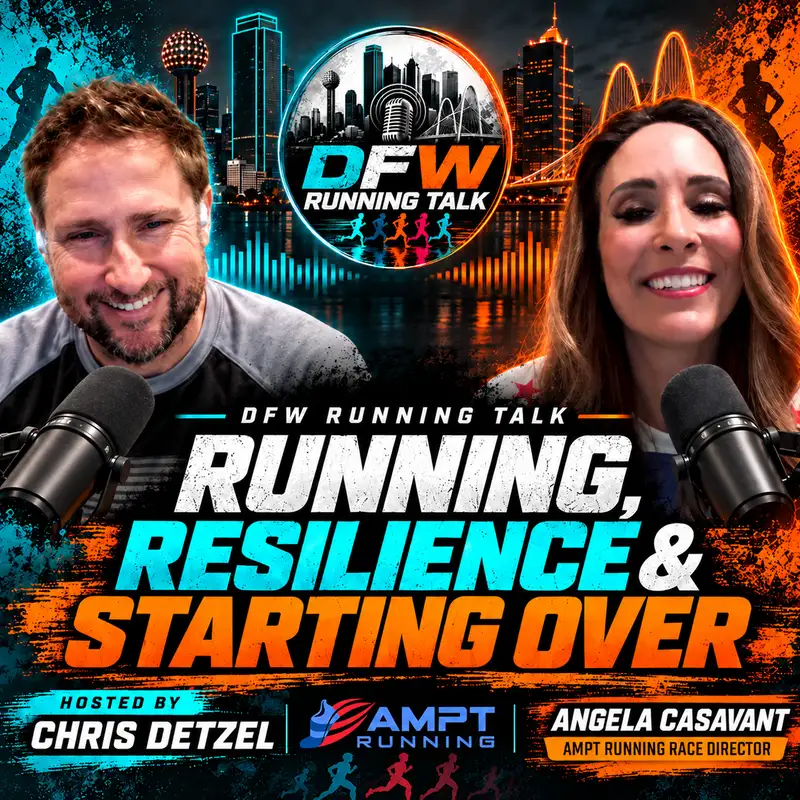
All right, welcome to another DFW Running Talk. I'm Chris Detzel and today we're talking to Angela Cosavant from Amped Running. Angela, how are you?
Angela Casavant (00:11)
I'm doing great. Thank you. How are you, Chris?
Chris Detzel (00:14)
I'm good. I'm so glad to get to talk to you. You and I have been kind of going back and forth for a few weeks and we're finally on. ⁓ and so I thought it was so it's funny because you're a race director and you know your races in Dallas Fort Worth are really big. I mean, and and a lot of people run your races. And so we'll talk a little bit about some of your races that ⁓ that you're doing and some of the things you're excited about. But first, I mean, you're a runner yourself. Let's talk a little bit about that. Is that fair?
Angela Casavant (00:43)
Sure, absolutely.
Chris Detzel (00:45)
Great. Let's start kind of from the beginning. You know, did tell me a little bit about kind of your I say upbringing from a you know, what kinds of th sports and things did you do in high school, college, or, you know, let's let's go from there. Was it running or was it something else? You know?
Angela Casavant (01:02)
Okay. Well it's it's funny because I am the most non-athletic person ⁓ that you'll ever meet. ⁓ so I did not do sports ⁓ in high school. ⁓ I didn't do track, cross country, any of that.
⁓ but I did start running at a very young age. And ⁓ at about 18, I just decided one day I was going to start running ⁓ using the treadmill at the gym I was I was going to. ⁓ and just you know, I used it as a form to stay healthy and and in shape and and little did I know that ⁓ I kind of fell in love with it. ⁓ it I always used
the treadmill at the time ⁓ it was kind of my cardio before I did weights and ⁓ every time I ⁓ you know had a child I would always instantly be able to drop the weight after hitting the treadmill, you know, for a couple months. And ⁓ I I did not start running outdoors though until probably about twenty I'd say two thousand and nine.
⁓ so ⁓ and then that's when I really started loving the sport. ⁓ I was like, wow, you know, being outside running is totally different than running on a treadmill. Yeah. Now now I hate the treadmill.
Chris Detzel (02:26)
Yeah. Running is way more fun than doing on a treadmill. Yeah, exactly. ⁓ how many kids do you have?
How many kids do you have?
Angela Casavant (02:38)
I have three. Yes.
Chris Detzel (02:39)
Okay. All right. ⁓ well you could probably I mean, I've had a lot of people on the show that talk a little bit about, you know, raising kids and running and you know, some of these people are extremely serious about their running. And so, you know, their partners or husbands, wives or whatever, you know, they have to really work in a partnership, you know, to really allow them to be able to do those things, you know. So, anyways, I digress a little bit. And and I'm sure that you might have some stories about some of that too. ⁓
Angela Casavant (02:51)
Yes.
Yeah. Yes.
Chris Detzel (03:08)
You know, especially being a race director. So I mean, so go ahead. Go ahead.
Angela Casavant (03:10)
Yes, yes, definitely. Well, it's it's just definitely ⁓ a sport that my husband said is not an you know an individual sport. He says it becomes a family sport because you know the whole family dynamics like with dinner time or morning, you know, ⁓ routines of getting kids up and ready for school all have to usually center around
Chris Detzel (03:25)
Yeah.
Angela Casavant (03:37)
you know, my running schedule. So ⁓ so he says it's not an individual sport actually.
Chris Detzel (03:44)
No it's not, not especially when you have kids and ⁓ you know, so all right. So you started kind of going outside a little bit. Did you like on the treadmill were you just running a few miles a day or something like that or?
Angela Casavant (03:47)
Yes.
Yeah, I just I started at the age of eighteen on a treadmill. ⁓ and then somewhere along the lines decided to start this outdoor running and it just started becoming a couple loops around the neighborhood into you know a 10K, you know, around you know, kinda ⁓
my residential area and ⁓ and then little did i know my my very first race was the bmw half marathon a a friend of mine who was actually a track coach ⁓ for wiley high school had invited me because she knew i loved to run and i also ⁓ i met her through refereeing basketball we used to referee high school basketball together and she she knew that ⁓ i loved to run and she said let's
let's run the, you know, Dallas half marathon. and so that was my very first race. I think that was in twenty ten, I believe. And ⁓ I've been hooked ever since. And ⁓ the rest is history. Now I, you know, I I do that event almost every year and ⁓ many others. So
Chris Detzel (05:09)
You know what's funny is ⁓ I think the first time I ran a half marathon was it was Dallas half marathon as well. And that was I think it was 2013 when I ran it. ⁓ but yeah, that's that's crazy. That's that's a it's a great
Angela Casavant (05:23)
Yes.
And I had no idea what I was getting myself into. You know, at that point in time, I don't think I did anything over seven or eight miles. And ⁓ I was thinking, ⁓ you know, what's 13.1? That can't be that much different than nine or whatever. And little did I know at the time that there is a little bit of a difference, you know. You kind of hit that if you're just not trained for those longer distances, you kind of hit that wall, you know, around mile 10 or 11. But ⁓ I just I got the race bus.
Chris Detzel (05:33)
Mm-hmm.
Mm-hmm.
Angela Casavant (05:55)
And the rest is history. So
Chris Detzel (05:57)
Did you start running with the group or?
Angela Casavant (06:00)
I didn't at that time. ⁓ I still did a lot of solo runs. ⁓ I didn't start running with a group probably until 2018, 2019. I found ⁓ some ladies ⁓ kind of in my area and they weren't really a part of a run group. It was just ⁓ kind of formed ⁓ with the you know, some stay-at-home moms and
⁓ I really enjoyed it and then ⁓ now I I hate to go out on a solo run. You know, I mean it is nice to get lost in your own thoughts, but I do enjoy, you know, socializing as well.
Chris Detzel (06:30)
Yeah.
Yeah, we'll talk more about that in a minute, but let's let's go backwards ⁓ to that to that race that you did in in Dallas. Did you you s you mentioned you weren't I mean, not that you weren't prepared, but you were thinking, how much harder can it be? Were you dying, you know, at the end or you know, what what is that like?
Angela Casavant (06:50)
Yeah. Right. I I wouldn't say I was dying, but I d I just remember ⁓ thinking to myself, man, if I had just trained for this, you know, or if I had just, you know, done some longer distance running, you know, prior to this, I would have done so much better. I think I finished in like two hours and like 40 minutes or something, you know. I I was just I was just
Chris Detzel (07:04)
Mm.
Okay. A little bit of walking.
Angela Casavant (07:18)
So happy to finish, you know. And ⁓ you know, I I think I had a pair of Under Armour sneakers. I mean, I just was so unprepared. Like I didn't know what I was doing. And ⁓ yeah, I of course didn't know anything about fueling or any of that. So ⁓ I was just I was truly an amateur going into it, you know, just some
Chris Detzel (07:20)
Yeah.
Yeah. Nobody does.
Mm-hmm.
Angela Casavant (07:40)
recreation running in around the neighborhood was about all I had done. So but I I finished and I was super excited about it and ⁓ and decided immediately as soon as registration opened for the next year, I I signed up again. So
Chris Detzel (07:59)
That's pretty awesome. Did you did you decide that like after that half, did did you decide ⁓ obviously you wanted to run that one again, but did you run anything in between, you know? I'm sure.
Angela Casavant (08:11)
Did I didn't do a whole lot of racing in between? ⁓ but what I did do is start ⁓ upping my mileage. So I was prepared the next year ⁓ for that, you know, half marathon. And then I just kept thinking I just want to work myself up to eventually doing a full marathon. And so ⁓ I wanted to kind of try to perfect my half distance and get it kind of where I wanted, you know, back.
Chris Detzel (08:31)
Really?
Angela Casavant (08:40)
Back in those days, I wasn't even so much worried about pace and all of that. ⁓ which, you know, now is a different story. But you know, I just I I truly was in it because I was loving it. I just I was loving it. And but I kept kind of, you know, practicing, so to speak. And that next year I went in and I think I shaved like 30 minutes off my off my half marathon.
you know, the previous year, so I was quite happy about that. But ⁓ but yeah, that's
Chris Detzel (09:14)
What would you say to first time runners then that do like a half marathon as they prepare if if you were to have some advice then? 'Cause I like that because you went from two forty to a two ten ish, right? You know, in the second one, and that's huge, you know.
Angela Casavant (09:28)
Yeah. Yeah. Yeah. I I think for anybody that's, you know, considering doing their very first half is ⁓ you know, research a little bit, you know, make sure you understand what what you're getting yourself into, everything from fueling to properly hydrating to getting enough rest.
⁓ to actually, you know, doing a training plan. It that all is so important. And I wish somebody would have told me back in the day, you know, that you could be a much better athlete ⁓ if you, you know, if you do these few little you know, do these few things. So
Chris Detzel (10:07)
Did some of that.
Yeah. You know, it's but back then, you know, two thousand ten, eleven, whatever, even thirteen, there just wasn't there was stuff on there. I'm not saying there wasn't anything online, but now, I mean, it's just there's so much stuff out there, you know.
Angela Casavant (10:21)
Right. It's not definitely it's it was nothing like what it what's out there today. You're you're absolutely right. And ⁓ I think a lot of people kind of started their running journey like in the early, you know, two thousands, maybe twenty tenish. ⁓ I I mean at least a lot of my friends ⁓ ha did and they're just a totally different runner today than they were back then. And you know, most of us are fifteen years of
Chris Detzel (10:39)
Yeah.
Angela Casavant (10:51)
you know, older, you know, but we're running we're having better races and, you know, r running more miles per month than what we were back those days.
Chris Detzel (10:53)
Yeah.
Yeah, I think a lot of things sh shoe technology is huge, you know, chafing, all these things that, you know, we kind of didn't know, or if we didn't know, we'd use Vasseline. I don't know, just this weird. So there's a lot more stuff out there for runners, and I and I think that's good. ⁓ so you ran that the next half, you know, in Dallas, you you ran more miles, you probably ate a little bit better and was a little bit smarter. When did you decide that, hey, you know what? I'm up in my game to the marathon.
Angela Casavant (11:33)
Yeah, I so that would have been in I'm trying to remember if it was when Dallas Rock and Roll, remember when they ⁓ came to Dallas, they ⁓ has since phased out, but I can't remember if it was that race or ⁓ BMW that just I I I did the half and it came so easy to me that I said okay, next year I am for sure gonna do the
Chris Detzel (11:43)
I do. Yeah.
Angela Casavant (12:02)
the full. And so I did. And that and so my very first full was in 2014 at the Dallas ⁓ you know, ⁓ marathon. So ⁓ I was very proud of myself. It there was a downpour that year, I remember, ⁓ around mile 18. ⁓ it just this torrential downpour. And ⁓ I just thought, my goodness, I, you know, this is it was
Chris Detzel (12:31)
Was it cold that day or n 'cause I remember maybe it was two thousand thirteen or twelve, it was like freezing cold and raining just the whole entire time.
Angela Casavant (12:37)
One year it was I don't I don't remember it being cold really. ⁓ in fact when I look back at pictures I I just have a a short sleeve shirt on so ⁓ it wasn't that bad but yeah I do remember it rained and then it just got so humid and ⁓ I just kind of felt like it kind of messed up my game. So but I finished and that's all that matters because you know it was my very first and I've kind of you know just like I had the
Chris Detzel (12:43)
Raining hard.
No cat.
Angela Casavant (13:06)
the race bug or the half marathon bug, ⁓ you know, years prior, then I had then I started to have the marathon bug. So, ⁓ so that was my first. And ⁓ it's it's it'll always be a favorite of mine too, because it was my first. So
Chris Detzel (13:23)
When you you keep going back to do the half every year, you said, so it obviously has a special meaning or at least, you know, I mean, I run it every year now too. Not it I mean it's a local race and I know a lot of people, you know, and it's just kinda fun to to do it. Now were you so when you trained for that one, you know, y y I'm sure you knew you had to run more miles, you know. How did you kind of think about that going into
Angela Casavant (13:34)
Yes.
I did. Yeah. I ⁓ I knew okay, I I'm gonna have to start training and doing more miles. ⁓ but life gets in the way, right? Like it always does. And and my training plan didn't go as I had expected for that first marathon. I think the most mile I think the highest my mileage was in my training was like 17 or 18 miles. ⁓ and I only did that once. Yeah. So I was like
Chris Detzel (13:59)
Mm-hmm. Sure does.
Yeah.
for the long run.
Angela Casavant (14:20)
⁓ I just felt really underprepared, but ⁓ I made the best of it. And ⁓ you know, the great thing about the first marathon, I think for a lot of us, is that we tend not to take ourselves too serious. ⁓ we really don't have anything to compare it to. We're gonna PR regardless because it's our first. And honestly, even though I was
Chris Detzel (14:24)
Yeah.
Yeah.
That's the attitude I think every marathoner for the first time should have, no matter what.
Angela Casavant (14:48)
Absolutely. And I just soaked in the moment and ⁓ just really enjoyed it, ⁓ even though I was underprepared, I think. So ⁓ but yeah, it it that's definitely one of my most memorable ones.
Chris Detzel (15:04)
So how s so going through kind of this, I guess what twenty ten to twenty fourteen or whatever it was. So you had four years kind of in between. I mean, you've been you're ramping up the miles, you're pretty much consistent, it sounds like, you know, besides some life things, but you know, how was your husband what was your husband thinking about this? You know? This newfound love of all this running, you know.
Angela Casavant (15:26)
Ha ha ha.
Yeah, he he just he never really understood the sport really until I think he got he got the race bug when he did his very first race. I r I convinced him to do the ⁓ Vegas ⁓ rock and roll half marathon with me. And ⁓ he ⁓ at that point in time, that was his first. ⁓ he kinda got that bug too and really started to understand, you know, a little bit more about, you know.
Chris Detzel (15:40)
Well.
Angela Casavant (15:59)
⁓ why this sport means so much to me. ⁓ I will not say he loves it as much as I do, but he certainly is a good sport.
Chris Detzel (16:11)
mean you're a race director, so you know, you do this for a living. We'll get that we'll get there, I promise, but
Angela Casavant (16:12)
Right. Yeah. And yes. Yeah. He definitely says that he he would much rather put on a race than run a race. Let's just put it that way.
Chris Detzel (16:19)
⁓
really? Wow. He doesn't like running that much now, or at least
Angela Casavant (16:31)
He he likes the shorter distances. I I I will say that. Give him a five K or a ten K. He loves that. ⁓ you know, and he's done great at some half marathons that he's done and he's done quite a few of them. But ⁓ I don't think I'll ever get him to do a full marathon. So
Chris Detzel (16:34)
okay. Yeah.
You know, it's funny little story. ⁓ back in two thousand eighteen or something like that. So I was running with DRC and things and and pacing the ha the full marathon, you know, like the three twenty group and you know, I liked it, but you know, to me it was it started to get the training just becomes a lot, you know. I had a kid that was probably seven or eight, I don't know, he's sixteen now, whatever it was back then, you know, he's young. and you know, I I just was always upset.
You know, and and I ran a few marathons and then my wife, yeah, we just got married then? I forget, but she was like, You know, Chris, you don't have to run marathons. You know, because I was there Yeah, she goes, You you don't have to do it. I mean, I don't y you know, you you don't seem to like it, you know. And and I realized that day, I like, Yeah, I don't I mean, so I just do a lot of houses. Point is like, you know, if if it's not for you, you know, go go shorter.
Angela Casavant (17:29)
Yeah, there are shorter distances.
Chris Detzel (17:48)
or do something else. But I just got big in the community and the relationships and sometimes you feel pressure, you know, to and and and some pressure's good. I'm not I'm not denying that. But ⁓ but you know, I was like, yeah, yeah, that's a good idea. And I haven't done a marathon since Yeah, exactly. ⁓ so he got into it kinda and I'm kind of curious to where you started doing some marathons and
Angela Casavant (17:48)
Yeah, definitely.
And I
Yeah and that's okay. That's okay.
Chris Detzel (18:15)
maybe halves or whatever, but you get s pretty serious about maybe some time stuff. I mean it's kind of what I was is is that true or, you know?
Angela Casavant (18:24)
Yeah. so I I wanna say it was after after I did my first full marathon. ⁓ it took me a couple years before I actually, you know, got brave and decided I wanted to do it again. And I did the Chicago marathon for my second. And ⁓ I realized ⁓
going into that I trained so hard and I I realized going into it that if you follow a plan and you trust the process that you can have great success. And I saw how well I did that I wanted to just strive to try to be Q someday. And so I just started taking ⁓
Chris Detzel (19:01)
Good race. Yeah.
Angela Casavant (19:15)
running a little bit more serious and started ⁓ really focusing on pace. I hired a couple run coaches along the way that kind of really helped guide me. And and you know, and I I'm still striving to get there, but I feel like ⁓ sometimes, like you said, you get a little burnout. And ⁓ I I have felt myself through through the years
get to that point. And then I've had to kind of step back because I don't want to lose the love of the sport. So ⁓ so it's kind of a little bit of a love-hate relationship I have with running. But ⁓ at the end of the day, ⁓ I just want to strive to do better in each race I do, you know. So and you can't you can't, you know, PR every race and I get that. ⁓ but as long as the effort's there, that's what's important to me.
Chris Detzel (20:06)
Yeah, especially many adults.
Yeah, the the way I it's funny as I get older, I don't say this as much, but I I do know that, you know, when you're younger, you know, there's always another race. And even now there's another race, but for me, you know, I'm fifty one. There's not many races I'm gonna PR, you know. So, you know, some of that I wouldn't say it's completely gone, but you know, it gets to a point where, you know, maybe you PR as your age group or, you know, whatever, you know, that kind of stuff. And so yeah, I think you have to kinda
Angela Casavant (20:28)
Yeah.
Chris Detzel (20:40)
Look at what is ⁓ realistic. You know, something you mentioned, and I'm I'm curious, is you mentioned that you've been burnt out before, but you come back. Talk about a time where you got burnt out, why you got burnt out, and then how you kind of overcame that and kind of came back to the running piece.
Angela Casavant (20:43)
Right.
Yeah, that's a great question. ⁓ I remember getting burned out when I want to say it was about actually three years ago. So it's just been kind of recently, ⁓ where I I did three marathons in one year, which for some people that's not many, but for me that was I just felt like the training never stopped. I just went right from one race into training for the next race and into the next one.
Chris Detzel (21:21)
Because I clutch. Yeah. ⁓
Angela Casavant (21:28)
And at the end of that third marathon for the year, I just I was so mentally and physically burnt out that I stopped running altogether. And I think I took about four months off, which ⁓ for me ⁓ was a long time to stop running. I I started to focus on other things, you know, cycling and some other things instead of running.
⁓ but every time I'd be in my car and I'd be driving somewhere and I'd see somebody out running in the neighborhood, I just instantly got you know, jealous that it wasn't me doing that, you know, and I instantly got inspired that I need to put those running shoes back on. But I do feel like taking a little bit of a mental break. ⁓ I I think that's okay. I and I and I stopped feeling guilty about it.
Chris Detzel (22:06)
That's funny.
Angela Casavant (22:19)
And just started realising that you know that's what my mind and my body needed at that time.
Chris Detzel (22:26)
Yeah, look, I I think that, you know, we can't do it all the time. I mean, we do a lot of running and and ⁓ you know it it it just you gotta take a mental break and and maybe even you know, my wife even says, you know, Chris, it's it's okay to go only run ten or fifteen miles in a week and and just allow yourself, your body to heal, your mind to heal. Because, you know, doing especially if you're, you know
running marathons and training for three marathons in a year, you know, that's that's a lot of marathons. And that's a lot of training, depending on how well you're trying to do, you know, that could be sixty plus miles a week, you know? I mean, that's 50 miles. I don't know, whatever. You know, it's it's still a lot, you know. ⁓ and so I think, you know, being kind to yourself, and and that is being kind yourself a lot into four months. I mean it doesn't sound like that long, but you know, in when you look at it,
Angela Casavant (22:55)
Yeah. Yeah.
Right.
Yeah, absolutely, absolutely.
Yeah.
Chris Detzel (23:21)
For a runner, it you know, that does a lot, it is a lot, you know, a long time. Like, man. But I mean you're still cycling and doing some other things, so you're staying active, it sounds like. But ⁓ I appreciate you telling that story. ⁓ have you have you got to a BQ yet or?
Angela Casavant (23:24)
Yeah.
Yes. Sure.
Have not, I've come so close, so so close on a couple different occasions. It just has not been in the cards yet. And I'm not gonna give up. and I'm just gonna keep working towards it, and ⁓ hopefully, maybe with age I'll be able to get there. ⁓ you know, that is the that's the beauty with ⁓ you know,
Chris Detzel (23:58)
It's gonna happen.
Angela Casavant (24:02)
going into different age brackets. You you know the BQ requirements. ⁓ right, right. So ⁓ but I've come so close. And so I I definitely feel like it it's attainable. ⁓ I think sometimes I just get in my head in the middle of a marathon and I'll be on pace and I'll be even with a pace group and I'll be doing so well. And I don't know what it is and why I
Chris Detzel (24:08)
Goes up five or so minutes.
Angela Casavant (24:31)
feel myself starting to bonk around mile I I mean I all almost all runners do, but around mile 20, I just start really getting in my head. And and so I need to just learn to, you know, it's more of a mental game than physically, you know. because I I I I can physically do it. I know I can. I just need to believe in myself.
Chris Detzel (24:55)
You know, it's f it's funny because a lot of a lot of runners do that, you know. I I know sometimes I I remember running with this woman and you know, she was we were running half marathons and her best half marathon at the time was like a one forty two or one forty three. But she was way more talented than that. You know, like you just know whenever you talked to her, you saw her and you like when you run with her, you're like, She she has all the talent in the world, you know. And and I remember during one race, I was like, Hey, I'm gonna run a one thirty five.
You want to stay with me, you know, we we're gonna run 135. I go, you know, so it's my god, I've never and I knew she could, but she didn't at that time. Eventually, probably like five months later, she ran like a 128, right? And so the point is is like sometimes we're in our own head. The other piece is, you know, when you think of like a lot of people bonk, but
Angela Casavant (25:34)
Yeah.
Wow. Yeah.
Chris Detzel (25:51)
You know, when you're going through that race, you know, in your head, you know, sometimes you just you get like you said, you gotta get it out of your own own head and and that's not always easy. And and I appreciate you telling that story. ⁓ how how close have you been? ⁓ I guess the question is 'cause I d I've heard this a lot. So a lot of people get because Boston changes its times and you never know. It could be six minutes, it could be five, you know, who knows? But
Angela Casavant (26:00)
Yeah. Sure.
Chris Detzel (26:19)
Tell me a time when you've been very close and and then how'd you deal with that?
Angela Casavant (26:23)
Yeah, you know, it's funny you're asking this question because I I was almost relieved ⁓ that I didn't be cue. It was a Chuck it was my second Chicago marathon and I missed it by three minutes. And ⁓ I was like, you know, once I realized what the cushion was, ⁓ that you had to I I mean
Think about it, like if I had finished and actually be cute, you know, say I came, I think at the time for my age group, I needed to do 350, I believe. ⁓ so say I came in at 349, right? ⁓ I still wouldn't have got in to Boston because I wouldn't have had that cushion. And yeah, and I think that would have been really devastating. ⁓ so it's almost kind of a relief that I didn't.
Chris Detzel (27:10)
You'd have been way more disappointed.
Yeah.
Angela Casavant (27:21)
⁓ but it just gave me something to try to push for, you know, the next the next go ahead. So
Chris Detzel (27:30)
Yeah, I mean, I know people that didn't get in by twenty they be Q, right? You know, but that cushion was just twenty seconds off and they couldn't get it, you know, or ten seconds or whatever. I think one guy was like one. You know, like I mean, could you imagine one second and ⁓ sorry, you can't get in. ⁓ so I wanna I wanna pivot a little bit, ⁓ because ⁓ you also do this kind of for a living. You put on races,
Angela Casavant (27:38)
No.
Right. ⁓ my gosh, yeah. ⁓ gut wrenching, yes.
Chris Detzel (28:00)
Ampere running, you're a race director. How did you get into that? Like what what kind of what was the starting point of that?
Angela Casavant (28:09)
Yeah, that's that's a great question too. So I actually became a ⁓ or got into race directing through a organization ⁓ that was one of the leading race production companies in DFW back back in the day.
And I was brought in at to kind of help manage some sponsorship and ⁓ not necessarily race directing. ⁓ so ⁓ kind of helping them manage their volunteers and their sponsorship, and I developed a good relationship with the race director at the time, who I kind of became their right hand lady, I guess. And really ⁓
Chris Detzel (28:40)
Yeah.
Who was it?
Angela Casavant (29:00)
Daniel Fleming, does that name sound familiar to you?
Chris Detzel (29:03)
I've heard of yeah, I've heard of his name. Yeah. I don't know him but I've heard of him several times from different people. Yeah.
Angela Casavant (29:05)
Yeah. Yeah. So he ⁓ he's been a race director for a few different companies in DFW. I I think he's moved on and is ⁓ not doing any of that any longer, but ⁓ I kind of learned a lot from him and a lot from this company. And ⁓ I was working full time for Samsung at the time and just doing that part time and ⁓
And really just enjoyed it as you know, I I was, you know, kind of just doing it, you know, volunteering and ⁓ decided that you yeah, yeah, I got to learn the ropes and d and just my love of running. I kinda learned, you know, what as a runner I think is important and what isn't, you know, I think most runners feel is important and and just kind of ran with that. And we did our very so that
Chris Detzel (29:42)
You can learn the ropes.
Angela Casavant (30:03)
company unfortunately ⁓ is no longer around. But we decided to do a charity event, my husband and I, for someone ⁓ at his work ⁓ to raise some money. And they said, well let's do a 5K and I was like, I think I can help do that. And next thing you know, the rest is history. I we did that 5K and then AMP was kind of formed in the process.
Chris Detzel (30:29)
So you did this five K did you say okay we're gonna do that five K every year now? Or did you
Angela Casavant (30:34)
No, it it was just going to be a one and done thing. ⁓ it was just going to be one of these things that, you know, we raised the funds ⁓ for the mission and and and then I didn't expect to ever do anything again, ⁓ as far as being a race director, but ⁓
something else came our way that we wanted to help raise funds for. And ⁓ so the second race happened. And then after that I was hooked. I was still working full time at Samsung. In fact when AMP running kind of first started for the first five years I had a full-time job. So I was doing that I was doing this completely on the side of of my yeah of my real job. So
Chris Detzel (31:19)
It's second job, yeah.
I mean that's ⁓ that's hard, you know, like I mean, just doing it during the night and the weekends. I mean, ⁓ I I I I can imagine what it's like. I mean I do events just for for work or partly event type stuff, community stuff, at work. And you know, venues and working with them and I mean just the little stuff on that. And I can imagine what you kinda go through. What I mean
Angela Casavant (31:25)
Yeah, it it was. Yeah. It it really was.
Yeah. Yeah.
Chris Detzel (31:51)
If it was just your job, I'm not saying it's easy, but it's easier just if that's the only thing you focused on. So ⁓ so talk about like kind of the and I told you I I like to talk about business. So we don't go have to go deep into business, but I am interesting to see, you know, how you kind of built the business of amp running and the race directing kind of or you know, in the races. So you do you started this and then we did this and that, you know what I mean? Like
Angela Casavant (31:56)
Mm, yes, yes.
Mm-hmm.
Chris Detzel (32:19)
Tell me a little bit about that journey and what that's like.
Angela Casavant (32:19)
Yeah.
Well, I just I knew after putting on those two ⁓ charity events that I kind of helped run the show and put together, I just knew that I wanted to I I wanted to turn this hobby of mine, which was running, ⁓ into something that could bring people together, families together, ⁓ to participate in
Chris Detzel (32:32)
Yeah.
Angela Casavant (32:53)
A sport that could also give back to special causes and charities. And so we just decided after those two charity events that we were going to ⁓ create two or three more races. ⁓ we, since my husband is in law enforcement and my son, my oldest son, is a firefighter, we decided that these three
races that we came up with, we wanted those to give back to different agencies, fire and police agencies. ⁓ and so we kind of used this as a way to, you know, give back to the community and also ⁓ give runners an opportunity to have a well organized event. And ⁓ you know, our first race, I want to say ⁓ was like 1200 people.
And ⁓ through the years it's just has, you know, these now we're up to six events a year. And then we also do client events. So we have ⁓ kind of like Eric ⁓ does where he's ⁓ you know, they're not his races, but they hire him to help produce them. So we have a couple client events that we do as well. ⁓ so that that keeps us more than busy right now anyway. So about eight eight
Chris Detzel (33:47)
Well.
Angela Casavant (34:14)
to ten total events a year is what we're doing right now.
Chris Detzel (34:17)
And you just focus on DFWs, all right?
Angela Casavant (34:19)
That's correct. Yes. Right now we're just in in D F W.
Chris Detzel (34:24)
And how long have you been, you know, doing the race directing? Like if you were kinda I know you kinda but just had the company, when when did it when did AM start?
Angela Casavant (34:33)
So we started in 2018 and ⁓ actually I take that back. 2017 was that first 5k that we did. ⁓ and then 2018 was the first half marathon that we did that was a charity event. And so ⁓ next year will be our 10 year anniversary. So we're really excited about that, that we've made it a whole decade. and and we've just got such a
Chris Detzel (34:37)
Okay.
Yes.
Angela Casavant (35:02)
wonderful following. I mean the runners in this community are like none other and ⁓ I wouldn't be able to do what I do at all if it wasn't for all the support from the runners, from our staff and team. ⁓ and ⁓ yeah and I I can now focus solely on amp running. ⁓ COVID kind of made that happen when ⁓ my entire Yeah.
Chris Detzel (35:27)
I was gonna ask talk about covet a little bit and how that affected everything. Yeah.
Angela Casavant (35:32)
Well, it was obviously such a scary time for everyone, but it was really scary for for me because I I lost my job like so many other people during COVID. ⁓ they ⁓ you know, they cut my entire department at Samsung. ⁓ so I was without a job. ⁓ obviously we weren't able to produce events because we were, you know, on you know, shut down and the whole the whole world pretty much. And so
it was a really trying time for me. ⁓ I was trying to pursue finding another job ⁓ back in the marketing field. ⁓ and just nothing was really opening up. But as soon as ⁓ as soon as kind of the world started, you know, coming around from COVID and people were starting to get back out into public and ⁓ events were starting to happen again, that's when my husband and I just decided to sit down and and have a discussion about making
you know, this my full time focus. And ⁓ and I never return back to ⁓ the corporate world again. ⁓ I've been solely doing amped running ⁓ since twenty twenty. So it's it's been it's been good. It's yeah.
Chris Detzel (36:45)
It's great story. I love that. ⁓ when you kind of look at all your events that you do, what's kind of the the most popular event? ⁓ is it the one coming up or is it, you know, something else?
Angela Casavant (36:58)
Yeah, so I would say by far the Toyota Music Factory Half Marathon 10K and 5K is a favorite. ⁓ we it like I said, perfect time of year. Weather's usually pretty good, you know, pretty nice. It's a great venue. But the ⁓ runner up to that is probably the Hot Trot Half Marathon 10K and 5K. ⁓ and that one takes place in August at White Rock Lake. I think people just love the lake.
⁓ there's not a whole lot of other races ⁓ or longer distance races in August in Texas. ⁓ so yeah, it's so hot. I know. It it is.
Chris Detzel (37:35)
I did that a couple of years ago and I was like, I'm not doing that again. I did the half and I was dying. Yeah, it was a great race, but I was dying.
Angela Casavant (37:45)
Yes, I I have no doubt. I you know, we see runners every year come out to that race and I'm thinking, you guys are braver than me. But a lot of people are you use it as a training run, you know, they're already training for Chicago or whatever, you know, upcoming fall event and they say, Why not? Sign me up for the half. So, ⁓
Chris Detzel (37:51)
Yeah.
Tripp is in
Yeah.
You know, it's funny is not to discourage you, but because that was my last half marathon in the summer two or three years ago. And the reason was not because of the race. It was just so hot that day that, you know, I ran well, but I was overheated and just sat there for like twenty minutes after the race just because I was like, and that's when I decided I'm not running a half marathon ever again in the summer. I'll run five K's, maybe ten, but no more than that as in a race, you know.
Angela Casavant (38:13)
wow.
Yes.
Yes. ⁓ Yes.
You know, I hear that all the time. You know, I try to I try to make myself, you know, ⁓ available to t during race day to talk to runners and see how their experience was. And hands down, the one thing I hear for that race all the time is is I wish I would have done the 10K or I wish I would have just done the 5K.
Chris Detzel (38:52)
Exactly. You don't ever go up to me like, look, before this race, y you're you can still go down to the ten K, you know, because I I feel bad for you. You're just gonna be really bad when you're done. No.
Angela Casavant (39:05)
Yeah. Yeah. Yes, yeah. But that's a favorite. We you know, we have a really good turnout every year from that race and ⁓ you know that just goes to show you that the DFW running community is just we're we're a bunch of crazy people. You know, we still get out there and we run, you know, in the heat. So
Chris Detzel (39:23)
I think it's a Texas people. There's this race, it's called Habanero 100. And I don't know if you've heard of it, but you know, it's in and you know, they have a 10K half marit or ⁓ 25k and 100k and a hundred miler. And it starts at noon in July or August. ⁓ it starts at noon and you start running. I did the 10K there once and I'm like, this is ridiculous. Like, why did I do this? You know?
Angela Casavant (39:28)
I have, yes.
Yeah.
Yeah. Yes.
Chris Detzel (39:50)
So so we are, we're all crazy, you know. ⁓ but ⁓ you know, doesn't there isn't there gonna be like ⁓ danger kind of stuff? I mean, what do you do as a race start if somebody passes out? What's the protocol for that? I mean I know you have
Angela Casavant (39:53)
Yes.
Yeah.
Yeah, we've we've had that happen a couple different times, especially at the hot trot. ⁓ we're just so fortunate to partner with s so many great cities that have, you know, medics on the course, ⁓ at the finish line, ⁓ that are able to jump in there and help. We had a gentleman that actually went into cardiac arrest at one of our events and it's just such a scary thing, but ⁓ Dallas FD is
Chris Detzel (40:08)
I'm sure.
Yeah.
Angela Casavant (40:34)
Awesome. And they jumped right in and ⁓ you know, and of course we have to have some, you know, we have protocols as well as as race organizers for things like that too. But you know, just having a good medic team ⁓ on standby on the course and at the site is really important. So
Chris Detzel (40:54)
So to get more the slight business of I I had a race director tell me one time, I think it his name's Rob Gwen and he said, you know, I never have a race and I don't lose money. And if I do, then I won't have that race again. You know, and I know sometimes, you know, maybe that's a sensitive subject, but you know, how do you look at races that are doing well, that aren't doing well, and then what do you do with some maybe that aren't, you know, doing as well as you'd like, you know, over I mean, sometimes it probably takes a little time to
Move it up, I guess, but
Angela Casavant (41:25)
Yeah, it does. So, you know, every race is different. And I always tell people, even some client races, you know, ⁓ if if I had a a a dollar for every email inquiry I get that says, Hey, I want to put on a 5K. We're trying to do this as a fundraiser, ⁓ I'd be rich, right? And I just want to tell them, go sell handy bars. Yeah. do you? Yeah. I'm
Chris Detzel (41:43)
Yeah. Yeah.
I get those emails just from doing this. I'm like, Yeah, because they want me to put on their w on they want to put on the website. They want you know, all all that's and I'm like, I mean, you might do this once, you know, like I mean maybe you do it a second or third time, you know.
Angela Casavant (41:56)
Website, yes.
I exactly. Yeah. It's just it takes so much time to build momentum and to really become for an event to become successful where you're actually making money. But I've just really have, you know, in some of the consulting I've done with people, I've just tried to set their expectations that, you know, you're you're not going to be making, you know, twenty thousand dollars your first year, you know, chances, you know, are very slim that that's gonna happen. So ⁓
Chris Detzel (42:11)
Yeah.
Angela Casavant (42:34)
You know, but you know as far as races, ⁓ we have some that do better than others. ⁓ have we had the discussion about possibly eliminating a race that's not doing as well as some of the others? Yes. ⁓ but I think our charity partners is what keeps me, you know, motivated. And even if, you know, we're only able to donate a couple thousand to them, it's it's better than nothing, you know. So ⁓
So I think we we have not had to eliminate any of our events and knock on wood. ⁓ we won't have to, but I can definitely see where some race organizers just dis you know decide that this race is not doing well. It's time to pull the plug. And with the costs of everything going up, ⁓ it makes it even more challenging to keep a race, you know, ⁓ going for sure.
Chris Detzel (43:28)
Yeah. I mean, when you look at some of these half marathons even, you can pay like two hundred bucks. And I'm like, Jeez. ⁓
Angela Casavant (43:35)
Yeah. Yeah. Well, and we get we get questions all the time, you know, well, why is it you know, back in the day you could sign up for a 5K for 30 bucks, you know, 35 at the most. You know, nowadays a 5k is gonna run you 45 to 50 bucks, even more, depending on what race it is. And ⁓ it's one of those unfortunate things, but
Chris Detzel (43:46)
That's right. Thirty bucks or less. Yeah.
fifty bucks. Sexty.
Angela Casavant (44:02)
race organizers just they they have no choice but to pass on some of the cost to the runner. And it and it's hard. it's hard to do. You don't want to, but ⁓ if you want to be able to keep the race alive, sometimes you have to.
Chris Detzel (44:17)
Talk a little bit about like one, volunteers. And then two, do you guys look at influencers or those kinds of things to help promote races? So I want to talk about the volunteers first, you know, because I know how important that is and you know, what the program looks like for you and and the races and and things like that. And then I wanna talk a little bit about how do you kind of promote that, some of these races. Like I remember talking to Eric and he goes, a couple of these races, man, they just
Angela Casavant (44:30)
Yeah.
Absolutely.
Chris Detzel (44:47)
promote themselves these days, you know, ⁓ that have been on for a long time, but you know, not not all of ⁓ you know, the ones that you want to do really well are probably, you know, as heavy attended as you want. So anyways, volunteers and then let's go from there.
Angela Casavant (44:49)
Yeah.
Sure, yeah. Volunteers, okay, they are the backbone of the business. They really are. They're the ones that get out there, you know, roll up their sleeves. They're there at the dark early morning hours. They're there late at night. ⁓ they're they're there
you know, problem solving, nothing that we do would be possible without our volunteers. And that includes we have ambassadors ⁓ who are volunteering, you know, their time, their efforts, their energy to help market the event and help with the production of the event. So ⁓ we're just so blessed to have such a great volunteer base ⁓ that
Chris Detzel (45:35)
Yeah.
Angela Casavant (45:50)
Like I said, what we do could not be possible without them. When you hear that term, it takes a village, it you know, it truly, truly does. And I can't I I can't be grateful enough for our volunteers and ambassadors.
Chris Detzel (46:03)
Do have a a program for ambassadors? Is that what does that look like?
Angela Casavant (46:07)
We do, yeah. We have a ambassador program. ⁓ it's a yearly program. So ⁓ they usually will apply in November, ⁓ and the season kicks off in January, and their ⁓ their term is through that whole season. ⁓ and we're so blessed to have so many amazing ambassadors that just come back year after year after year.
⁓ they they truly enjoy it because they have a passion for ⁓ giving back and ⁓ seeing our events become a success. And ⁓ you know, for some people, you know, it's it's time consuming and they just don't have that much time to give. And we totally understand that too. But yes, our ambassador program is instrumental in doing what we do.
Chris Detzel (47:00)
D do you give them incentives like a free race or I mean what what is that?
Angela Casavant (47:05)
Yeah. Yeah. So the ambassador program is is got all kinds of perks, you know. ⁓ of course a big perk, you know, they get to run the race for free. ⁓ but I truly believe that they don't sign up to be an ambassador strictly for that. ⁓ they get to see all the behind the scenes that goes into race production and they truly
Chris Detzel (47:11)
Okay.
Or Racea.
Angela Casavant (47:27)
enjoy ⁓ helping bring an event to life, you know. So ⁓ but yes, they get to participate with comp entries into the events. ⁓ they can get buddy comps for their friends. ⁓ they get amped apparel. We do this huge incentive program, ⁓ which, you know, ⁓ is fun. We have an end of the year big, you know, gala and party. ⁓ so yeah, they
Chris Detzel (47:39)
Okay. ⁓
That's cool. I like that. That's fun.
Angela Casavant (47:57)
They really enjoy ⁓ being a part of the community and that's what it is, is that, you know, ⁓ myself or my husband, we we can't take ⁓ you know, ⁓ we can't what what's the word I'm trying to use? what what has formed with the amped community is not because of us. It's truly because of what the ambassadors have done. So
Chris Detzel (48:22)
Yeah, but I mean, I I agree. I mean, if it wasn't for them, you know, the races wouldn't be as successful or maybe successful at all, or you know, ⁓ but also, I mean, you have to give yourself credit too. I mean, you've created this, right? Like you cre you created the programs to allow those people. And to me, like being able to create the programs to allow those people to do those things, and yes, it's it they're very great, you gotta be very grateful for them, but you know.
Angela Casavant (48:35)
Well
Chris Detzel (48:50)
That's hard work is trying to come up with what's gonna work as an ambassador program or what's gonna work to get people to do things that, you know, and it's throwing the party, it's it's being probably a kind human, you know, and and it's also a little bit of incentives and things. And then you've created this kind of, you know, I don't want to say cult like, but this kind of thing that people love, you know, and they wanna continue to help out and you know, so I love that. You but you have to create the program.
and and make it successful and you did that, you know. And so I understand what you're saying and agree that it takes them, but what I know exactly what you've done and I know how hard this is. And ⁓ I I appreciate that because you know it's it's not easy. I mean, yes, you you have to have those those volunteers. And most race directors, you know, if they have multiple races, they they beg borrow still volunteers however they can.
Angela Casavant (49:26)
It's hard for me sometimes to take credit, but yeah, I see.
Chris Detzel (49:49)
And they're trying to build programs ⁓ kind of like you have, you know, and and some do really well and and some don't because why? It's hard. You know. So it's really hard. You know.
Angela Casavant (49:49)
Yeah. Yeah.
It is a lot of work. It absolutely is. It it is. Yes. And you know, our regular volunteer base, you know, just people that aren't ambassadors, you know, we offer a program with where it is, you know, you volunteer for one, you earn one. So, you know, we'll get a lot of people that will sign up and in the early part of the season, they'll volunteer at a race because maybe they want to run.
Chris Detzel (50:14)
Yeah. Hmm.
Angela Casavant (50:24)
To IOTA, you know, and get a comp entry into that raise later in the year. And so this is a way of them, especially with the economy the way it is, and people just, you know, don't have eighty bucks to sign up for a half marathon or whatever the cost might be at the time. You know, this is a great way of them still being able to participate, you know, and earn a comp entry. Yeah.
Chris Detzel (50:41)
Two programs. And I like that. You know, one is, hey, you know, you you don't have to be here for a year. You can just do one and get one, you know, kind of thing, whatever you want. And then there's this other program that's, you know, for the elites. I like it. You know, the elite helpers. Yeah, exactly. So I love that. That that's a great story. And so I assume that that's kind of where you get your
Angela Casavant (50:49)
Yep. Exactly.
Yeah, yeah. The people that just want to keep coming back. Yeah.
Chris Detzel (51:08)
Let's just call them influencers, people that are just talking about the race, doing things on Instagram and things like that.
Angela Casavant (51:12)
Yeah, it is. Yeah, we have about 65 ambassadors and they ⁓ they are amazing at marketing our events, you know. ⁓ that is part of the criteria to be an ambassador is that you know you, you know, you're not just yeah, you you're you don't just show up on race day, but you know, you're you're kind of out there to help, you know, market the event and share the event with your ⁓ you know with your ⁓ community.
Chris Detzel (51:28)
There's sixty five of That's a lot.
Angela Casavant (51:42)
And ⁓ and so yeah, as far as the influencers, I mean I've got sixty-five of them and I love them. ⁓
Chris Detzel (51:48)
I love it. Do what what happens when, you know, maybe one of them starts slacking, you know? Maybe they're no longer or I mean, is there criteria that, hey, I mean, I'm sure you're kind about it, but I mean, what do you do when somebody gets too busy and just can't really do it as much?
Angela Casavant (52:02)
Sure.
Absolutely. And it happens. You know, we get it that, you know, life happens, you know, ⁓ you know, and we truly believe that everyone that signed up for that particular ambassador term had great intentions and wanted to stick with us for the year, but things happen and sometimes, you know, life gets busy and or you know ⁓ takes them in a different course. and they just decide they need to kind of step back and we're totally supportive of that.
Chris Detzel (52:10)
Sure.
Angela Casavant (52:35)
⁓ and you know, and it's not like you know, we're going to guilt them, you know, into continuing the the program. Yeah. No, and we've had a lot of them that are I shouldn't say a lot, but there's been a few that have said, you know, I just life has gotten too busy. I just can't, you know, continue with the program. ⁓ but we still see them come out to the races, they still sign up to volunteer.
Chris Detzel (52:41)
Just don't come back next year. No, I'm just
Yes.
Angela Casavant (53:00)
⁓ you know, and we always say once you're a part of the ant family, you're all you know, you'll always be a part of the ant family. And we truly believe that. So we're there to support them regardless if they're an ambassador or not.
Chris Detzel (53:11)
Well what else I have lots of other questions, but you know, we're kind of up on time here. But is there anything that I missed about either your running journey or, you know, amp running or just in general, anything that, you know, that we missed or?
Angela Casavant (53:32)
I can't think of anything other than the fact that DFW has the best running community ever. And I am just so blessed that they let amped running be even just a small part of their running journeys. I know everybody has ⁓ you know, a different story and a different journey. And ⁓ you know, whether it's just one race that they've done with us or some, you know, participate in all of them, that I just wanted to share that I'm very ⁓
grateful. I know Phil is very grateful that we've been a small part of their ⁓ their story. So ⁓ AMPT will probably be ⁓ bringing another event. ⁓ I can't say a whole lot just yet, but we will probably be bringing another event ⁓ in the near future. So ⁓ we're still working on that. So that's something that ⁓ maybe the next podcast we do together I can kind of share more details on.
Chris Detzel (54:29)
Dell it.
Angela Casavant (54:32)
But ⁓ as of right now, we're we still have our we we're about to launch our 2027 registration, which I'm excited to do, which we're gonna reveal all of our 2027 swag. ⁓ great shirts, great medals, and a great series, ⁓ challenge series that we're offering. So ⁓ I just I guess stay tuned for all that information coming in the next week or so.
Chris Detzel (54:57)
Well that's exciting. Wow, you got me all excited. I wanna ask you so many more questions now, but I guess I have to wait. I might actually ask you later on, you know, ⁓ about shirts because I want to get some DFW running talk shirts and I'm like, I don't know he even to go through on those kinds of things, but maybe ⁓ you can hook me up with a name or something like that. So ⁓
Angela Casavant (54:59)
Yeah.
Yeah.
Yeah.
Chris Detzel (55:23)
I am well Angela, thank you so much for coming on, telling your journey, talking about your journey, how you get into race directing, and you know, so many cool things going on for you and in the DFW running community and what you're bringing to us, you know, is is really awesome. People love races. You know, you get one coming up in November. ⁓ so that's it's it's gonna be awesome. And so, but thank you so much for coming on and thank you everyone for tuning in to another DFW running talk.
Make sure you go to DFW running talk.substack.com, get to the newsletter. We have over 2,000. We actually have 2,100 people that are signed up for that newsletter. ⁓ get a new website, check it out. It's all it's all a bunch of resources, things like that. So until next time, Angela, thanks again.