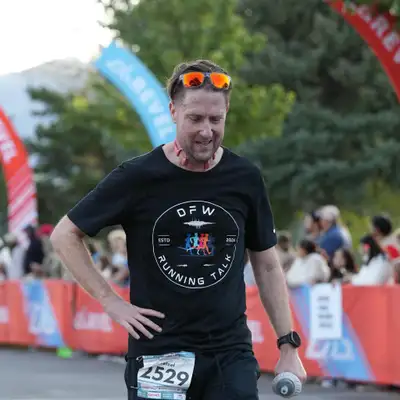
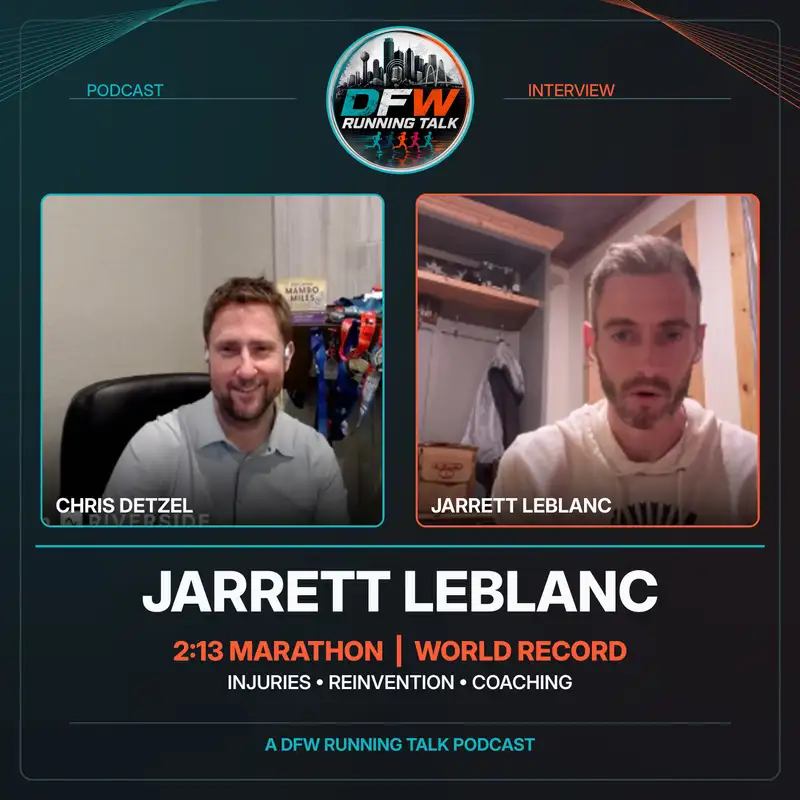
Chris Detzel (00:00)
Alright, welcome back everyone to DFW Running Talk. I'm Chris Detzel. Today I'm sitting down with Jarrett LeBlanc, and this guy has one heck of a running story. So we're gonna be talking to someone who's run a 213 marathon. He's broken a four-minute mile, he's completed in two US Olympic marathon trials, and even set a world record for the fastest half marathon on a treadmill. But what makes Jarrett's story so interesting isn't just how fast he runs, which is pretty impressive.
He started as a college walk-on. He was told in his running career that it was going to be over. he stepped away from the sport and then eventually found his way back. So, and through all of that, he has four kids, hospital shifts, ⁓ obviously raising a family and it's still competing at an elite level. So today he's taking everything he's learned and using it to help runners set their goals through coaching. So, which is we'll get into that in a minute. So, Jarrett.
Welcome to DFW Running Talk. I'm excited to have you here.
Jarrett LeBlanc (01:02)
Hey, thanks for having me. Love the intro.
Chris Detzel (01:05)
Good, hopefully it was pretty c accurate.
Jarrett LeBlanc (01:09)
Right on it, man, right on it.
Chris Detzel (01:11)
Good. So you grew up in Hathaway, Louisiana, surrounded by, I guess, rice fields and twenty-eight students in your graduating class. Take me back there. What was that like? What was that life like and how how did running become so important to you?
Jarrett LeBlanc (01:24)
Yeah, you normally when I describe like where I'm from, I tell people that I graduated top 10 of my class. And then I go on to tell them, yeah, I graduated with 28 people. ⁓ you know, it's one of those towns, we don't even have a zip code. It's a caution light gas station kind of, kind of town. ⁓ you know, you have to drive to the nearest town and go get your groceries and all that good stuff. But, you know, it's runner's paradise, honestly. I mean, for Louisiana, I we don't have hills, we don't have like trails through the woods, but we have soft surface for miles, you know, and.
Chris Detzel (01:31)
Exactly.
Mm-hmm.
Jarrett LeBlanc (01:55)
I utilize that a lot when I was younger. I still had many training runs over the last 10 years. I'd go back home and do a run or something like that. But, know, growing up in a small school, you competed with other small schools. So you'd get third at a race and you'd run something that was just, I mean, you could probably power walk it to get top five, to be honest. And it's just, you don't know what you don't know. And, you know, you think you're good. And then you really started kind of zooming out and
looking at the big schools like in Baton Rouge, New Orleans, Lake Charles, Lafayette. And then you're like, well, yeah, this really isn't fast. I need to get on some, getting on a training program or something. And ⁓ our high school coach was actually our principal. She was just a moderator. So we had to have a warm body for practice. And she would say, well, if cross-country is three miles, you probably need to run three miles every day. And we did that for the first year. And obviously it...
You know, fizzled out and I had to learn how to coach myself and did that for four years. But yeah, high school was not very, it was a nice point in my life because, you know, I found something that I was decent at and I was able to kind of inspire other people with it. But I was a mediocre 434 1600 meter runner, a 202 half mile, and I broke 10 minutes for the 3200 and I ran 955 my senior year. You know, those times back then were walk on to a small D1 school.
And I walked on down the road to McNeese, which for me was a culture shock moving into a big city and going to school. But ⁓ yeah, nothing like a small town living, I'll tell you what.
Chris Detzel (03:29)
So when you went to McNey State, at what point did you go from thinking like, I'm just happy to be here or believing that you can compete with kind of the best runners in that conference? How was that?
Jarrett LeBlanc (03:39)
Well, I actually got lapped off the 5,000 my first, my freshman year, second to last place in the steeple in the same meat. So that was May of 2009. I had, started in August of 08, but I remember sitting down in my coach's office and being like, you know, this isn't for me. Like I'm, I'm not cut out for this. Like I'm just, you know, I'm from Hathaway. Like I, I probably need to go work for my dad, work in a shop, you know, he has his own tire business here in Jennings. And
Chris Detzel (03:44)
no.
Jarrett LeBlanc (04:06)
you know, just thinking the negative things, not really looking at, you know, how positive training impacts positive racing. I, if it wasn't for that summer where I just kind of put my nose to the grindstone and just ran and trained, I probably would not be sitting here talking to you. That was the change was I just stuck it out one summer, ran 70 mile weeks and came back the next year. And I was probably top three, top four on the team ⁓ going into my sophomore season.
Chris Detzel (04:09)
Yeah.
So you eventually won the conference like a five K and ten K double double and broke a record that stood for a long time and it was it stood for like twenty years. I don't know if it's still there, but what changed between that runner who couldn't could barely walk on to college to kind of the mentality, you know, what you just ran that seventy miles or what flip
Jarrett LeBlanc (04:54)
Well, know, from me now being a coach, looking back, it just took time. know, I guess I was what Coach Gilroy called a diamond in the rough. You I didn't have much volume background. I was running 20 miles a week in high school. Sometimes I'd get up to 40, but I would never run, you know, more than three days in a row without just randomly taking a day off. I didn't know the structure of training. ⁓
Chris Detzel (05:02)
Yeah.
Yeah.
Jarrett LeBlanc (05:21)
So it took a while to kind of build that aerobic base to where you can handle running sub five minute pace for 10K on a track or being able to, you know, kick or run a fast mile. it, things like that just took time, kind of like it does with marathon training and things like that. But just believing in the process of just putting in work and showing up every day that good things will happen, ⁓ you know, and surrounding myself with teammates. You know, I got offered, I did walk onto McNeese, but I got offered a partial scholarship to another college.
down the road in Lafayette, but the coach tried to recruit me as the number two guy on the team, whereas at McNeese, I was the number nine guy coming in. So I thought, well, if iron sharpens iron, need to be running with faster guys than that. So again, having fast guys to chase really helped.
Chris Detzel (06:10)
I I I think you're right. Like I it's funny because I run with a lot of groups here and talk to a lot of folks and I remember this one guy telling me, you know, if I can get under a 230 and he runs with a group that runs 230s and things like that. He goes, We can have a lot of people here in Dallas running under two thirty, which now we do, but or have a few. ⁓ but it's just that same mindset. If you're running with people that are training as hard as you or harder than you, some people that are faster than you.
You know, that it goes a long way, obviously.
Jarrett LeBlanc (06:41)
Absolutely. ⁓ I've always said that and you know, lot of the ⁓ younger athletes I coach, I look at their high school schedules and ⁓ the ones that I can modify. I'm like, hey, we're not going to go to Pine Prairie where there's, you know, ⁓ 17 people running this race. We're going to, we know we can win it. Yes. But why not? Let's, know, let's go across the border. Let's go to Texas or hey, let's go to the Choctaw trail this weekend. Go run a race. You know, put yourself around people that want to, you know, do better.
and you're going to follow as well. You may even leave the pack, but it's going to change you. It's going to make you grow. ⁓ Sometimes it's harder. Sometimes it's more challenging, but that's the point of it.
Chris Detzel (07:27)
So after college, from what I read, there was a c a coach that just basically said, Your competitive running career is over. You didn't believe them. Right.
Jarrett LeBlanc (07:38)
Well, that was actually my college coach. I had run my last race that night when he kind of embraced me and told me that it was the 10,000 meter at the NCAA prelims. ⁓ What's funny is that Paul Chalimo ⁓ was in that same race with me. He went on to qualify for nationals and, you know, he's ⁓ so far made a great Olympic career and stuff like that. you know,
looking when I remember in that moment thinking man like I could have done so much more ever you know in college you know I was here for five years I had a whole red shirt Pross and track season and I was like what what else could I have done more and you know everyone they always want to ask you what your what your best time is and as a runner you either have a mile time or a marathon and obviously I wasn't training for a marathon at the time and my mile time in college was 408
had a very good 1500 meter time. was 346, which equivalents to about a 403, 404, but I never ran that, never ran fast. So I just wanted to pursue that and try to break four and see how close I can come. And I just kind of trained hard for a year, ran 401. And then I obviously joined a post collegiate team, trained hard for a year and ended up running 359 a year later. But yeah, no, that...
When he told me that and it was like a reality shock, like, like, yeah, when, people are in this situation, you have to kind of respond and either go back to the real world, which is the W2 job, go to work, find a, you know, find a career and get after it or continue your schooling education. ⁓ but from a realistic standpoint, running should have died. It should have stopped right there. The competitive side of that thing. But, you know, I just, I kind of said no, and I just kept pushing for it.
Chris Detzel (09:14)
Yeah.
So funny, you you mentioned the 359.95 miles. So in 2015 you ran a 3595 mile. So becoming the first Louisiana native to break four minutes on Louisiana soil, which is pretty awesome. ⁓ so you made it by five hundredths of a second. Walk me through that final lap. What do you remember? And by the way, I watched that video. It's pretty cool.
Jarrett LeBlanc (09:35)
Yeah.
⁓ Tough man. I don't know if you've ever run so hard to where you start seeing black and white, but ⁓ I couldn't see colors. ⁓ And you know, when my form, when I start hurting, it gets pretty bad. You know, my shoulders come up and I start squinting at the eyes, gritting the teeth. And, know, you have coaches and fans just saying relax and there's no relaxing at that point. ⁓ you know, I felt really good. The first two laps felt like
Chris Detzel (09:50)
Ha ha ha. ⁓
Jarrett LeBlanc (10:12)
I was holding my breath. came through the half, the true half mile at about at 158, maybe 159 low. And then all of a sudden, you know, that third lap sneaks up and we come through 1209 or, 1206 meters at, 301. And so mentally I'm like, now I have to run my fastest lap just to get under four. You know, if I run the same pace that I'm running now or the same pace as that first lap, I'm still won't break four.
And I was mentally prepared. you you start thinking of things like, okay, what can I, can I fall? Can I fall and still be the hero? Right? Like, you know, that's the, that's the, that's the real, the realistic thought that went through my mind. I'm like, I could fall and people will feel sorry for me and I could have made it, but no, I fail. You know, and just the negative things just start coming in your mind, just like trying to attack you. And, ⁓ with 300 meters to go, my teammate, ⁓ he just yelled go.
Chris Detzel (10:48)
You go through all of that.
Yeah.
Jarrett LeBlanc (11:09)
And the minute he did, like I just had this shot down my spine of goosebumps. was just adrenaline just went, just put my head down, just started turning over and I just felt myself getting faster and faster and faster until I had about a right.
Chris Detzel (11:22)
And you were. You can see it. You can see it in the last actually two or three hundred. So
Jarrett LeBlanc (11:27)
Well, yes. And then I get to about 109 to go. And unfortunately, where Lake Charles is in Louisiana, that highway that the track is on goes straight to the Gulf of Mexico. There is nothing blocking that road. So you have the Gulf wind coming straight up Common Street and it takes a detour. Yeah, it goes right on the track. And then you can see the big banners. They're like bending down and you're just fighting through that. it's just...
Chris Detzel (11:43)
Then you can see it.
Jarrett LeBlanc (11:53)
You're battling the lactic, you you're trying to just get to the line, get to the line. And in my head, I was actually counting. Like when I hit, ⁓ like the 1500, I heard somebody yell three 44. And so I was like, okay, I got 15 seconds to go 109 yards. And I just kind of was counting in my head, just, you know, trying to take two steps, two or three steps for every one second that passed. ⁓ yeah, no, it was, it was super exciting. It was a storybook ending for that, you know, 359 95. I mean,
When Gilroy obviously yelled, you know, started yelling on the mic three, I didn't care if it was 359.99 or it could have been 351. just knew I was under it. that was the, you know, since that was the, that was the goal is to get under four. So it was a great, it was a great experience. still one of my favorite, favorite races of all time that I've ever done. ⁓ just really enjoyed it. Yeah.
Chris Detzel (12:44)
And it's on video that's the cool thing. You know, you could always go back and relive if you wanted.
Jarrett LeBlanc (12:49)
Yeah, that's yeah, they did a good job putting that together. And ⁓ it's always there for my, you know, for my pain and pleasure, I guess you could say.
Chris Detzel (12:52)
Good.
So there's plenty of people chasing goals, maybe not of under, you know, four four minutes, but what did the pursuit of that sub four minute mile teach you? and are you still using some of that kind of inspiration or whatever it was today?
Jarrett LeBlanc (13:15)
absolutely. ⁓ You know, in running, we always want everyone else to do great too. It's like, ⁓ have trouble with some athletes. They, want everyone to win. And I'm like, that's great. You know, that's good, but you got to want to win for yourself just a little bit more sometimes in a competitive style race. Now from a goal setting though, like it just shows you that hard work determination is possible. It's not a, it's not a fairy book. It's not something you see on TV or see on YouTube or Instagram or Tik TOK like.
Chris Detzel (13:31)
Mm-hmm.
Jarrett LeBlanc (13:45)
It's there. You just got to want it and make sacrifices for it. No one's going to hand it to you. ⁓ There's going to be bad days and there's going to be hard days. There was many days where I would show up, run a workout and I'd walk away and my coach at the time would be like, he's like, yeah, that ain't going to break 4'10 on race day. And I'm just, I'm just new. It was a bad day and you're going to have bad days and you're going to have good days. eventually, running plays no favorites.
So you kind of have to pick and say, well, look, you know, it's going to be me today. ⁓ So, you know, just to kind of keep being continuous with that. Hey, hang on one second here, Chris. Hey, over there.
Chris Detzel (14:24)
Yeah, no problem.
Jarrett LeBlanc (14:27)
Go put your diaper on. Hang on, Trace. Hey. Hey, go back and see Mommy now. ⁓
Chris Detzel (14:33)
We'll cut all this out.
Jarrett LeBlanc (14:38)
I don't think anybody wanted to see that.
Chris Detzel (14:42)
but it did. We'll cut that piece out. So you ran the sub four ⁓ sorry, you ran the sub four mile, and then you started running, you know, a marathon. You ran a 213 marathon. Those are very different events. So when did you realize you wanted to do something like that?
Jarrett LeBlanc (14:44)
Yeah. Yeah.
Well, ⁓ even since high school, like when I was in high school, one of the big workouts that I would do would be a long run. And then I would take like two days off, right? Because it was just such a, it was such a experience for me. But I always liked running long and hard and just, I always enjoyed the long run. So actually when I was, when I ran sub four ⁓ in January of that year, I actually ran 104 for the half and I actually qualified for the marathon trials. ⁓
But it's good strength work because I tell all my athletes, know, short and long, that strength is king. It doesn't matter how fast you can turn your legs over. You know, if you've got the right strength, can lock in on that speed and just go. I have some good friends of mine that they could never run faster than like a 420 mile, but they would beat me at 5K just because they can lock in on a certain pace and just grind. that was early college days. But, you know,
It was kind of always a mix of knowing like, all this mild training is going to help for the marathon because if you're more efficient at running fast, shorter, you're it's only going to help your running economy for, you know, running slower and longer. ⁓ a lot of our big workouts that we, did for the 2016 and 2020 trials, two separate coaches, but the same style was, you know, we're going to run these big workouts and they're going to last long, but you.
when it comes to race day, you get to slow down. You get to literally just almost hold your breath for the first 10 to 15 K of a marathon because you're so used to running so much faster. And it does help. It mentally helps because that at the end of the day, especially in the marathon, it's more mental than it is physical. There's so much more mental barriers that you have to tackle on race day that are.
one and lost right here between the ears. It's nothing that the course has to give you. It's nothing that the temperatures have to give you. We know those are variables that can affect things, but it's literally how much can you callous your mind? You know, how much can you callous your, you know, your body wants to just sit there. So the minute you start walking, it has to figure a way to tell you, Hey, let's sit down. So just from getting up and walking across the house, you've already callous that your mind on that. So now let's train the mind.
Let's callous those inner feelings and inner thoughts to say, slow down or hey, stop and do this. ⁓ So I love it. I love the grind about that.
Chris Detzel (17:32)
Like that.
I love that. ⁓ so you mentioned in twenty sixteen you qualified for, you know, the the Olympic marathon trials. Were you injured kind of during the training cycle or you know, what was that like?
Jarrett LeBlanc (17:47)
It was, ⁓ I ran the 20th. So after the mile, ⁓ in 2015, was already qualified for the trials, which were in February, the next year in 20, ⁓ 2016, I ran the rock and roll, ⁓ San Jose half marathon where, ⁓ rub shoulders with Deb Kofleski for like seven miles. It was a great race. I ran another one four, a great effort. And when I got home from that race, I just remember something just felt a little off. ⁓
So I took some time off and I actually ran and won the space city 10 miler back in 2015 that year. So that was right after span Jose. And, right after that race, I knew something was definitely wrong with my back. I ended up having a sacral, a stress fracture. and if it's anything in the back and the lower, lower back pelvis area, most people know that like anytime, you know, you, you've got so much muscles that want to protect the bone.
If you have one little piece that's just starting to flare up, all your muscles just tighten and it's just such a, there's no relief there. You know, so that lasted, it lasted about a year. ⁓ it lasted through the trials. lasted. So my, my, true, the 16, 20 week buildup for the Olympic trials was nothing. It was, I would put together a long run or a workout and take four days off. would run four days, take four more days off. was very.
I was just holding on to kind of whatever fitness I had. wasn't gaining anything. If anything, I was losing it. But yeah, it was hard because you're going to the line knowing that you're not healthy. It's hot in LA. I think it was 78 at the start for our race or 76. Even for a Louisiana boy, that's hot. I mean, I was training in the Woodlands at the time, but it was hot. I got to 13 miles and I'm pretty sure I started walking at like 16 or 17.
Chris Detzel (19:22)
Yeah.
Thirteen. Yeah. What do you do you remember your time on that?
Jarrett LeBlanc (19:44)
I split right at 70. It was a group of like 40 of us that were all kind of in similar situations where our fitness wasn't so great, ⁓ injuries. And we all just kind of looked at each other from there. And if you look at the results, we were all within six or eight minutes of each other. I'm sorry, four to six minutes of each other. ⁓ And we all just wanted to finish. We didn't care. I we knew our Olympic dreams were gone when the gun went off, but we wanted to see if we can get top 10 or top 20.
Chris Detzel (20:13)
When the gun went off, we knew we were done.
Jarrett LeBlanc (20:14)
You know? Yeah, pretty much. Pretty much.
Chris Detzel (20:19)
So does that have something to do with kind of this ten miler that you've talked about in the past that ⁓ you ran this championship you ran this ten mile and two No, no, you're fine. So you ran this ten mile in in twenty sixteen, ⁓ and you crossed the finish line and you you retired. Was it because of the back or what was going on?
Jarrett LeBlanc (20:25)
Go back over there. Go see Mommy. Say sorry about it Chris.
Yeah, so it was. just, I felt like I had finally done what I needed to do. I needed to run a marathon. I broke four. Like what more could I really wanted to do? And so I retired and I was like, you know, I'm too injured. I had a sponsor, a rabbit had picked me up after the trials and ran the USA 10 mile champs. And after that race, I just, I had struggled to get to line healthy again. And it wasn't more so like the back. was just,
⁓ you know, I had my first career job, like I had moved to Wyoming and you know, just life started taking over and I was just like, man, like to, to, be good at running, like you have to give up a lot at this level. And I'm like, you know, could I have ever broken 220? I don't know. Maybe I'll just, maybe I'll just start getting big now. So I just started hitting the weight room and putting on pounds and actually got up to like 175 and you know, I, I,
Chris Detzel (21:23)
Yeah, yeah.
Jarrett LeBlanc (21:38)
I remember signing up for the Boulder Boulder 10K just as a whim. had some buddies that were still doing the post-collegiate thing that were living in Boulder at the time. And I ended up going down there one Sunday spent or Saturday spent the night, ran the Boulder Boulder in like 35 minutes, 36 minutes, but it was a hard 36 minutes in game. there's no, you're at altitude, you're out of shape. You know, for someone like me, like I would run.
Chris Detzel (21:56)
Tim K.
Jarrett LeBlanc (22:05)
36 minutes in case at the end of an easy 10 mile run, you know, that's nothing for someone like me. So it was an eye opening fact to be like, man, like, but the competitive juices like got fired up more than ever. And I was like, I'm pretty sure I could train and get even faster than I was before. And that was in May of 2017 when I ran the Boulder Boulder. yet. No, not as long as I would have hoped. It was a short lived retirement. ⁓
Chris Detzel (22:07)
Yeah.
So you don't retire for long.
Yeah, exactly.
Jarrett LeBlanc (22:34)
But yeah, then a year and a half later, I'm running 213 in the marathon. But I was completely out of shape.
Chris Detzel (22:39)
Yeah, talk about that. That was at CIM. But that was at CIM, right? ⁓ and you ran your two thousand you ran, you know, the two thirteen. Walk me through some of that. or you know, kind of training, because you mentioned that you were hurting, you or I mean that you were injured kind of in twenty sixteen and things like that. So walk me through kind of yeah, yeah, go ahead.
Jarrett LeBlanc (22:43)
Yes.
Hang on a second here, Chris. Hang on one second. Come here.
Hey, hey, we have to keep him in here.
Chris, sorry about that.
Chris Detzel (23:26)
No worries, man. That's you know, that's the kids they're they're curious, you know. So
Jarrett LeBlanc (23:28)
So, I know curious creatures. Yeah, so that when I actually moved back home in January of 2018 or December of 2017, ⁓ when I started training, I was actually healthy. I was just not in shape. And so learning how to balance the mileage and the real job when I moved back home, that was more of the key. That was the hardest part.
you know, my coach, ⁓ I still have the same coach. He lives in Santa Barbara. So two hour time difference, but he understood my background with running. Like I was a, a speed guy, didn't care for the 5k, but liked the marathon training. And so we were able to come up with a training plan that really fit, you know, what I like to do. ⁓ but when I ran CIM, I just, I didn't have enough, ⁓ I guess the structure right word to say is.
My schedule wasn't right for training leading up to CIM. ⁓ We nailed everything, the consistency part, the speed workouts, the not getting injured, the fueling with our long runs didn't manage up to what we wanted to. I ended up working two 16 hour shifts back to back almost every other weekend on top of my normal Monday to Friday job. And so it was just kind of hard to like feel fresh to go do 22 miles or so.
Chris Detzel (24:53)
Mm-hmm.
Jarrett LeBlanc (24:55)
We struggled on that part and I think I always blame the walking at 26 miles on that part. I just ran out of gas just a little bit too soon, ⁓
Chris Detzel (25:06)
Well you still ran a two thirteen fifty. I mean that was pretty I mean you walked what the last four hundred yards or so?
Jarrett LeBlanc (25:09)
Yeah.
Well, I walked for a little bit then I got up and I started running again. But you know what was what was so funny though is my girlfriend, my wife here now, but girlfriend at the time was there and she's like, look, I want you to get fifth place. And I just laughed at her and I was like, fifth. was like, I was like, Katie, there's a there's a lot of guys here that that are like, they do this professionally. Like, I'm doing this on the side. Like, this isn't like this isn't my day job. I got to go back to work on Monday when we get home kind of thing. But you know, this
Chris Detzel (25:33)
Ha ha.
On your Slacker.
Jarrett LeBlanc (25:39)
This is a big deal for them. If they lose to some guy like me, they're going to have to go back to training and figure out what they're doing. ⁓ But I found myself in ⁓ fifth place with a mile to go. And I was like, I'll be dang, I've got to do it. I've got to get fifth now. I was side by side with Brendan Gregg. He ended up winning, I think, CIM the next year. But anyway, ⁓ we're starting to pull away from the rest of the group.
We were strong out by then, but of course, right when I saw the 26 mile banner, I just felt this lightning pain in the dead center of my chest. And I made like a cramp. Just, it took over and I just, I was hunched over running, getting to the banner. So I stopped at the banner and I'm trying to stretch my arm while walk, while walking. And then there goes fifth place, sixth place, seventh place. And, ⁓
Chris Detzel (26:30)
Uh-huh.
Jarrett LeBlanc (26:33)
One of my rabbit teammates like slapped me on the back and he was like, not right now. Come on, get to the finish. And so I started just kind of hobbling going and I ended up kind of getting up to speed, but that last 200 was probably very ugly. I did the, the lactic robot or the, you know, trying to hold my stitch in. felt like it was just coming out of my chest. You know, just one of those painful experiences, but, ⁓ but yeah, but the entire race for 26 miles, I mean, it was perfect. I.
I had my bottles down, I negative split. mean, I was probably in 30th place at the 5k, 20th place at 10k. You know, I moved up progressively. just, my goal was never fifth place anyway, but my goal was to run the Olympic B standard at the time, which was 215 flat. And so we were well under that goal. Yeah. Our, you know, my first 5k was about 215, 214 pace or 214 high.
Chris Detzel (27:11)
Okay. Yeah.
Okay, you did it.
Jarrett LeBlanc (27:31)
And then we just started getting into the five O's for mileage and it just mile after mile. ⁓ And I will say though, you know, I'm from Louisiana. So like if I run 70 miles in a week, I'll gain about 250 feet of elevation, which is nothing. is laugh. It is very laughable on how flat. Yeah, I run in Dallas, but there's some hills there. You guys can find some hills if you wanted to, but we can't, we have to do overpasses.
Chris Detzel (27:37)
Clicking it now.
That's right, I do.
I'm in Dallas, so it's the same. So
Yeah. Yeah. Yeah. Yours yours you're gonna like Houston, basically. Yeah. I mean Houston there's no it's all a hundred percent
Jarrett LeBlanc (28:01)
Yeah
Correct. And yeah, it's hard. But when I got the CIM and I remember the first like 12 or 13 miles, I was like, I'm going to kill my coach. He told me there was no hills in this course and it was like net downhill 300 meters or, know, I'm like, there is some, there's some hills on this thing. And I was just upset about it. You know, I was like, I can't wait to tell him how mad I am about this. But again, me from Louisiana, I can notice an ant hill, you know, a mile away.
So it's just.
Chris Detzel (28:35)
Exactly. Yeah. Well, if you ever run in Colorado or anything, then you know, it's it's even worse.
Jarrett LeBlanc (28:42)
I did, yeah, no, I've lived in Wyoming, I lived in Colorado for a while too, so I know what real hills and elevation are, so.
Chris Detzel (28:45)
Yeah. So you know.
Yeah. So, you know, you made the Olympic tr ⁓ trials twice, one in two thousand sixteen and twenty twenty, and you've experienced retirement and a lot of setbacks. So looking back, which accomplishment or turning point means the most to you?
Jarrett LeBlanc (29:07)
⁓ you know, just the ability to kind of keep, keep running a priority. ⁓ you know, I, I deal with a lot going through with, with the injury, especially in 2016, cause it was just relentless. mean, we were doing underwater treadmill, ERP, there was just so much stuff that was going into it that felt like it was a dead end. remember I had like two good weeks that I was able to kind of do some
running and biking. then one day I was about, it was like a six mile run and I was heading back to my apartment and a half a mile away, my back just felt like it just seized up so hard. couldn't even walk. So I just laid on the ground on the side of this road in the woodlands, just screaming. And someone thought I got hit by a car. And I told him, was like, no, I'm just upset with myself. Very much, yes. was very, but you know, it...
Chris Detzel (29:58)
So in a temper tantrum.
Jarrett LeBlanc (30:03)
It kind of, teaches you just be grateful like when you are healthy and when you, you know, when, when you have your things together, when you're, when your body's able to respond, you know, being able to push, you know, when you can just grateful for a healthy life, you know, there's, ⁓ I'm very grateful that that was the last, you know, knock on wood injury that I had that really kind of took me out. I've had some strains here and there, but those are, those are a dime or dozen. Yeah.
Chris Detzel (30:28)
That's good.
Jarrett LeBlanc (30:31)
I've dealt with some Achilles tendonitis, tendonopathy for years just because the way my stride has changed over the years. I used to be a heel toe striker. Now I'm just basically on my toes. So my Achilles gets a lot of pressure. ⁓ but, ⁓ yeah, I feel like, ⁓ I'm just being, I'm just really grateful that, ⁓ being injured and seeing the light through it, you know, on the other side has really helped me as well.
Chris Detzel (30:44)
Yeah.
That's awesome. And and I appreciate you you sharing that. So some another impressive let's let's go all the way to 2023. ⁓ in July of 2023, you ran a 102.50 on a treadmill, roughly at 447 a mile. ⁓ and I think you're raising awareness and funds for children's with ⁓ congenital heart conditions, that's right.
So most people can't even imagine running a four forty seven, by the way. You held that pace that entire way. ⁓ on a half marathon on a treadmill. I think that was a record and all that. Walk me through some of that.
Jarrett LeBlanc (31:36)
Sure. for context, my buddy, John Ranieri lives in trains in Flagstaff, Arizona. He actually broke the world record during COVID. When COVID happened, all the races shut down. there was a group that started that, that kind of got the running phase again, going like, Hey, let's, let's do some, let's do world record attempts or let's do a half marathon, marathon, 50 K. And John got it. John ran one three eight, which, he did it at altitude too. I will say that. So
Honestly, yes, I ran faster than him, but I did it and he did it in like a garage too. So it's like, you know, clearly the guy was, you know, on an insane mission to try to run at 7,000 feet in Flagstaff, just hopped on a treadmill and went. Now when I did it, ⁓ I was coming back from taking time off after my daughter was born in 2021. And I was like, you know, I need some motivation to kind of get me through.
Chris Detzel (32:05)
Mm.
Jarrett LeBlanc (32:30)
training again and you because the work was just relentless during COVID. You know, you're working overtime, you're wearing all the masks, you're taking showers, washing hands. I mean, it's just, it's just tiring. So it's like, why even put the effort to try to train for something when there's not a whole lot out there in 2021, 2020 kind of thing. And so I was like, well, maybe in a year or so, I'll try to break this treadmill world record or something. And I ended up teaming up with Camp Boncour, which is a, it's a congenital heart camp for kids in the area.
And these kids don't have the same, they try to have the same lifestyle as normal kids, but they have to have so much more restrictions. And it's kind of like bubble play for them. Some of them have, some of them are born with half a heart. Some of them have two heart valves as opposed to four. Some have tight valves, some have just non-working hearts. so it's just a spot that I see a lot because by trade and career, I'm an echo tech. So I'm a sonographer. I do heart ultrasounds on
Chris Detzel (33:10)
Yeah.
Jarrett LeBlanc (33:28)
on babies just like tonight, I scanned a 26 week old in the NICU. 26 weeks is not a whole lot of, it's still got some cooking to do. obviously the heart's underdeveloped as it should be and ⁓ developed enough to work but underdeveloped for real world settings. But I see stuff like that a lot sometimes on a daily basis and...
It kind has a soft spot for me. obviously we, was like, you know, if I can get the community behind me and say, Hey, look, let's just raise some money and I'm gonna just hop on a treadmill and run fast. Let's just see if we can, if we can do this. And we did, we ended up raising over 20. I think the final number was close to 23 or 24,000. ⁓ Yeah. Most of that donation came from the gym where I did it. Red Leroy. He was actually Mr. I guess what you would call Olympia before it was Mr. Olympia back in 1961. ⁓
Chris Detzel (33:54)
Yeah.
Awesome.
Jarrett LeBlanc (34:22)
After the attempt, he actually donated the treadmill to me and my family and he gave me, my wife, my daughter and my unborn son at the time, lifetime memberships to the gym. and I guess as a runner, he knows I ain't gonna go throwing around 600 pounds of deadlift and you know, but then that's why he donated the treadmill to me. I'm sure he wants me to run on that one versus the new ones he got, you know, but such a nice guy and a nice gesture, but.
Chris Detzel (34:33)
Well
Yeah.
That is awesome.
Jarrett LeBlanc (34:50)
It was a great motivation. got me in shape. It got me motivated, you know, to start doing some stuff. ⁓ So yeah, that was a great time.
Chris Detzel (34:59)
I love that. What a great story and ⁓ you know, wow and what a great time. does that record still hold or?
Jarrett LeBlanc (35:07)
I don't think it does to be honest. think there's a guy that ended up running like mid one one twos and I'll say, and I'll say that about that. There's, there's probably 50 or 60 guys that can schedule it on a Saturday if their training allowed it and said, I'm going to go run, you know, I mean, look at that. Look at the top American that ordered a top three Americans, the guy who got, he was third American at Chicago. think 10th overall, the, Maury Vincent or Vinnie Maury, you know, he, does all of his training on the treadmill, basically all the big heavy stuff. And
Chris Detzel (35:08)
Okay.
Okay.
Yeah.
Jarrett LeBlanc (35:35)
I'm pretty sure that was a workout that he did. He ended up running like a, you know, under that pace for like 90 minutes, which means he would have eclipsed my record going through, you know.
Chris Detzel (35:46)
Well, I I I I say it like this is or I see it like this is my wife, I'll give you an example of k why I think this. So my wife, ⁓ she's she's run like thirteen Boston marathons and you know, she's fast for her age now, and and ⁓ point is like we did this five K one year and there's like three thousand people there and there's about a thousand women and she got first place, right? And she she and her thought was, well, you know
Just nobody fast showed up. I was like, you showed up that day. You were fast that day. And you're the you you won. Right. And so, you know, the way I kind of see your ⁓ record is is that okay, fifty other people can run that fast, but you know, ⁓ they haven't. You know. So let's just let's just be I I I understand what you're saying and you're probably right. But you're the one that did it, you know, and ⁓ and and so I think that you've got to own that.
Jarrett LeBlanc (36:19)
If.
Sure, sure.
Yeah. Sure.
Chris Detzel (36:43)
know not I'm not saying my god I'm the fastest guy no but fair enough but it was you that day you know so ⁓ yeah so all this kind of running you've been doing and and I really appreciate that background but I I think you know you went from kind of this elite athlete and still running at elite level you know the way I found you was I was looking at the space city 10 miler and ⁓ 5k
Jarrett LeBlanc (36:47)
Yeah. Yeah, I like it. It's good though.
Chris Detzel (37:10)
And I saw that you won it somewhat recently, ⁓ 5103. So I know you mentioned, you know, kind of during our talk, you've won that three times. which is cool. Which is awesome. You know, that's that's pretty impressive. Are is that are you doing that for a reason? Is is that are is there like points you get or something like that? What is that? No, you're just
Jarrett LeBlanc (37:24)
Thanks.
I mean, they picked up 800 bucks for the mile premiums and overall win, which was diaper and formula money for me. I honestly, it's like I can make that on a Saturday or I can go make it on a Sunday for 50 minutes, you know, kind of thing. ⁓ But no, you know, when runners kind of get into the training thing, can kind of get not stagnant and not just boring, but just almost the same thing. Like you're trying to build this, what you call base, because I'm honestly trying to put
Chris Detzel (37:32)
Okay.
Exactly.
Jarrett LeBlanc (37:58)
you know, an OTQ on my calendar, which is an Olympic trials qualifier. And, you know, I don't know when that's going to be, honestly, because life with these kids and, you know, having multiple businesses and jobs and shifts and being on call, I just have to be ready for an opportunity when it comes. And so I'm just going to be ready to strike when I'm be like, you know what, I could sign up for that in eight weeks and do it versus, I got a half a year to train because something's going to happen. it's, it just, that's my life story. I feel like.
things always kind of fall into place that way. So I just need to be ready for an opportunity. And I've talked to my coach about it too, because originally I wanted to run the marathon project in December. And the next thing we know, we were looking at the calendar, looking at the timeline. I'm like, yeah, my mileage isn't where it needs to be to try to run 213, 214. So we actually, I actually just confirmed, I put the Woodlands on my radar. So I might go down there and I got accepted into the elite field, I kind of reached out to them.
Chris Detzel (38:45)
Yeah.
Jarrett LeBlanc (38:56)
It seems like it's close by. That's another thing I go off of. you know, we won't fly for many more years either because of the kids. like, and how far can we get in a car with the four kids and four car seats? It's like, there's only so much that you can take. And really in Louisiana, there's very little opportunity to run fast at anything above 10 K. So, you know, with that being said, my wife is running Houston full. So I'm on coach daddy mode that weekend. So we'll be there.
Chris Detzel (39:05)
Okay.
Jarrett LeBlanc (39:26)
I have a lot of my own athletes running there as well. So it'll be good to take a step back from the coaching side. I mean, from the running side competitive and just be coached, be present, you ⁓
Chris Detzel (39:37)
Two things there is I'll be in Houston as well, running the half and maybe I'll get to see you. ⁓ say hello say hello. But ⁓ and the other thing you should come out to Dallas one time and try that half or full, you know, Dallas Marathon has like thirty thousand and I yeah. Yeah.
Jarrett LeBlanc (39:41)
Nice.
It's in December. It's in December, right? Yeah. So I actually kind of put, I put that as funny that you, when you had messaged me like literally like two days before I was searching some Dallas races and I raced Sergio Mena ⁓ in a 5k over the summer. Yeah. He's cool guy. ⁓ I've raced him once. We've probably crossed paths in college before, but raced him at the firecracker 5k ⁓ in Shreveport.
Chris Detzel (40:06)
Yeah, yeah, I've had him on. Yeah.
Jarrett LeBlanc (40:19)
Went up there to visit my sister and her kids and I just happened to sign up and raised him there, but I'll have to reach out to him and say, hey man, might be coming to Dallas for a good hard half marathon effort. It would line up good to run a fast half there. ⁓ I've got some family in the Wiley area ⁓ and so I'm pretty familiar with running out there.
Chris Detzel (40:35)
Yeah.
Yeah, well let me know. ⁓ I know the guy that puts the elite field together, whether you do the half or full, you know, might be able to at least get you in that field for sure. So ⁓ one of the things that ⁓ you do now, you're a coach, and you mentioned this several times, and tell me a little bit about the philosophy, the name of your coaching, what you know, what it means to you personally, and and how does it influence your ⁓ the way you coach.
Jarrett LeBlanc (40:49)
Sweet.
So I've been coaching since, officially since 2021. ⁓ I came up with the name, Levee Breakers. I was sitting on my front porch out in Hathaway, holding my daughter while my wife was going off for a run. This was postpartum for her. obviously just, she is now, yeah. She ran 15 miles today and she progressed it very beautifully. Like just.
Chris Detzel (41:27)
She's a runner.
Jarrett LeBlanc (41:36)
To me, there's nothing better than a progression run. I feel like that's the fitness secret right there, progression runs. ⁓ But anyway, she was running on this levee behind my house and it's the rice field. So it's not like this big, massive levee that you see, but I just imagined her running so hard, like fast that the levee broke and the water just started pouring out. And I was like, ⁓ levee breaker. And it just clicked and I was like, man, I really liked that name. And that was...
You know, my daughter was born in May. That was, it was very shortly after that, cause she wanted to start moving around, you know, but I ended up running the power mile in New Orleans, like in September or August that same year. And I just told her to levy breaker Jersey. And a lot of people might've thought that I was like throwing some hate on New Orleans, like with the levees, like, and I had to explain, I'm like, no, like this is, this is rice field levy breaking. Yeah. So, but, ⁓
Chris Detzel (42:30)
Gotta change it.
Jarrett LeBlanc (42:33)
No, they accepted it. knew they know who I am down there and they really, they were really happy to see me kind of start something. And, but yeah, ever since then, I've just kind of been growing a little bit of the, coaching clientele. obviously a lot of people want to go to Boston. So a lot of marathoners, ⁓ I've had my fair share of high schoolers and, I still have them now, which is it's fun because I get to like, really tell them that there's a big future with running, especially on how fast they are. You know, I've had coached some.
Chris Detzel (42:37)
Mm-hmm.
Yeah. I think s I think there is now.
Jarrett LeBlanc (43:03)
Yeah, I mean, you know, it's cool to want to be a basketball player and do these things. But like running has so much future. You can connect, you know, it's like a marketing level that no one's ever taught you. you know, every everywhere I've gone, I've met someone that was a track athlete. You know, it's just it's a really fun thing to have ⁓ in your arsenal of communication and just experience of life. mean.
I went around the world and I went to Africa for two weeks and I would have never done that if I wasn't a runner. You know, I was, there's just so many cool things that running brings you ⁓ outside of, outside of competing.
Chris Detzel (43:40)
I love that you said that because you know if you ever listen to my podcast and most of or lot of the episodes, you know, I talk about what where running has taken me all over the world, you know, and ⁓ and and I meet a lot of really great people. It's a great community. ⁓ DFW has a great running community. there's probably 50 or 60 running groups here in the DFW area. And it's it's insane like how big running is. ⁓ so I I I agree with you. I mean it's just
Jarrett LeBlanc (44:04)
Wow.
Chris Detzel (44:11)
Like I I go to a lot of places, you know, just because of it, you know, and it's kind of fun. ⁓ so you kind of describe yourself as a low mileage runner, ⁓ and even while competing at such this, you know, really high level ⁓ elite level, what do you believe runners misunderstand about mileage and improvement? 'Cause you know, I hear a lot of people just say, I do eight miles and just skip.
Jarrett LeBlanc (44:35)
Yeah, and unfortunately, like if you run more than likely, you're gonna get faster, right? Plain and simple, more miles, more opportunity for your body to build fitness, and that's true. But you have to figure out, or you have to consider life. Like most of us work, most of us have families, most of us don't eat 100 % healthy. ⁓ Most of us when we do train, like yeah, like it's very hard. ⁓
Chris Detzel (44:42)
Yeah. Yeah.
Sorry. It's hard.
Jarrett LeBlanc (45:04)
double ⁓ Texas Whopper today. Like that's okay because I mean, it's just, is what it is. Like we just didn't have time. Like now I cooked a gumbo tonight, but like, and still like, is that healthy? Probably not. A lot of salt. ⁓ But you know, there's just so many things that people don't, yeah, so many people don't think about like the extracurricular outside of just running mileage, but you know, you can, and I tell this to a lot of my athletes, I either say, you know, if you're going to run today, 35 minutes and then shut it down. Keep it easy.
Chris Detzel (45:07)
Hundred percent. Yeah, it's fine.
But you can handle it.
Jarrett LeBlanc (45:33)
and don't go longer than 35 minutes. Keep your recovery run short because you're defeating the purpose of a recovery run. then, can you...
Hey, don't do that. Hang on a second.
So I thought it was funny to put a balloon in the fan and it got stuck. But no, yeah, the high mileage thing, know, and it's real big right now, especially on social media. Like you'll have the David Goggins thing of like putting the mileage together and consistently running it. I'm sorry, Chris, hang on one second, Go back over there. Go. Don't turn the light off, Go. Hey, don't. Go.
Chris Detzel (46:10)
So later.
Sorry.
Jarrett LeBlanc (46:35)
Thank
Turning the lights off like it's a disco show or something in here. But yeah, the high mileage thing, it's very prominent right now and it's hard as a coach. The easiest thing for me is to slow people down and cut miles out, honestly. Because everyone wants to do more and more. And I don't throw shade to CrossFit. My wife does it four or five times a week. It's great. It gets to a point where it's like you need to start choosing. Like if you're going to do
Chris Detzel (46:43)
I saw that.
Yeah.
Jarrett LeBlanc (47:07)
strength training in a certain way, anaerobic training, like they can mesh very well together, but they have to mesh. You can't stack them both like this is some kind of Lego masterpiece. You know, there's a place for recovery. There's a place for strength. There's a place for, building. But to me, the most important aspects. And I think that's why I'm still doing it at this level at 36. I mean, I've been running for over 20 years and I've been running competitively for, you know, more than 10 years.
And it's because I still take days off. I took today off. I'll probably take maybe Friday off or Saturday. I still take at least one day a week off and I've done that for years. I've never run. I've never been one these guys that just tracks my and fair play to those people. You know that some people haven't missed a run in three years, five years. Like that's great. But like at the end of the day too, when we do stop running, we have bodies that have to keep us alive. Like we, you know,
Chris Detzel (47:57)
Mm.
Jarrett LeBlanc (48:04)
There's such thing as kidney damage, there's such thing as heart damage. That's more important than the running 10,000 days in a row or whatever people want to try to do. To me, there's so much bigger things that we try to overlook. You got people doing peptides and supplements out the wazoo, but I'm like, have you taken a day off? Have you tried that for recovery? ⁓
Chris Detzel (48:30)
Exactly. Yeah.
Jarrett LeBlanc (48:31)
Have you heard of that before? Like a day off? I guess it's really great. Yeah. Yeah. ⁓
Chris Detzel (48:34)
It's okay. It's it's good for you. I I'm a big fan of taking days off. I ⁓ usually always at least take two days off a a week. You know, I don't generally run I have before but I don't run six days a week. I certainly don't run seven. So
Jarrett LeBlanc (48:52)
Yeah, I haven't run seven and probably in quite a few years, obviously just with the kids like, you know, and with work, it's just, it's hard. But I will say like, if I can put six, six days a week together, I can still run 70 to 80 miles a week. I've never run over a hundred miles a week and I don't ever plan to, that's just my thing. I think I ran 98, like three times in a row, but never did a hundred, never ran more. but fair.
Chris Detzel (48:57)
Yeah.
You d you just didn't want to get to the hundred, huh?
Jarrett LeBlanc (49:21)
Yeah, I know, right? Like I just, well, I guess I thought like back then, like, well, there's going to be more eventually, right? Like I may, I may build up to 105, 110, but I just never did. I ended up, ⁓ that was after that was right before 2020. ⁓ but yeah, no, it just never, never had that inkling. Like my fitness relied on a specific number. ⁓ you know, I knew if the volume was there, you know, that fitness would follow. ⁓ I tried not to just hone in on one number or a mileage number. ⁓
Chris Detzel (49:26)
Yeah. Yeah.
I love that.
Jarrett LeBlanc (49:51)
If I felt fit, I knew I was fit, but it was also because I was taking days off for recovery.
Chris Detzel (49:57)
You know, speaking of kind of training like during the summer with Louisiana being really hot and humid, same thing Dallas, you know, it's similar. What do you what do you think some of the big mistakes that runners make when kind of training through those conditions and you know, how should they adjust their expectations?
Jarrett LeBlanc (50:05)
Mm-hmm.
Well, what they should not do is they should not go on Instagram and watch David Goggins and then proceed on a training run. It's look, it's easy. I've been guilty of it. You get caught up in the moment. You're like, but in reality, you you guys were y'all are in Dallas have hotter temperatures than we do. We may have more humidity. And if you equal them out, they're pretty much about the same thing. It's going to give you a disastrous temperature field to run in essentially. ⁓
Chris Detzel (50:17)
Exactly.
Sure, sure.
Jarrett LeBlanc (50:42)
It just, it's so muggy. think like, ⁓ even like four weeks ago, it, yeah, I was in Dallas for some summers where the, you know, it's 10 o'clock at night and it's still 102 degrees. I'm like, this doesn't make any sense. You know, this is ridiculous. ⁓ the dry air is nice, but that doesn't, you forget about how dry the air is 10 minutes into your run. And then you're just trying to forget how hot it is. But no, I,
Chris Detzel (50:45)
Overtime's rough, dude.
Yeah.
I don't think it's that dry. I mean it it does dry out, I guess. In the morning it's very humid. We get seventy to ninety percent of humidity in the mornings. But it does dry out a little bit during, you know, the day. It's just hot as hell, you know.
Jarrett LeBlanc (51:10)
Yes.
Sure. Right. Yeah. But no, the biggest thing is like converting marathon pace training, right? So like everyone wants to do a marathon pace run, some kind of workout that indicates marathon fitness. So for instance, I had a, I had a gal that ran in Chicago. She PR in Chicago by four minutes and ran 248. We could not get her to run more than probably six miles straight at 630 pace. You just can't do it. You just can't do it in Louisiana. And I'm sure you can't really do it in Dallas either, but
Chris Detzel (51:34)
Okay.
Jarrett LeBlanc (51:44)
The biggest thing is trying to convert those bases like, okay, from my experience and my knowledge, a 630 at 76 degrees and 97 % humidity is worth about a 705 mile or a 651 mile. And so let's convert that. And, the problem is, like after you run for an hour, now what's that conversion? Because now you have the effect of all your blood is now at the skin cooling it. So is this...
Is a 630 equivalent still to a 651? No, it's probably more like a 710, 715. The effects get astronomical the longer you stay running in those temperatures. And that's the hardest thing. ignorance is bliss, right? But unfortunately, knowledge is power. And knowing that and trying to explain that on a reasonable scale. I've had athletes tell me, like, so I'm going to run 45 seconds slower than my marathon pace for an hour today.
and it's gonna hurt. How am I supposed to do this on race day? And I'm just like, trust the process and trust that it will be cool. Trust that it will be colder on race day.
Chris Detzel (52:47)
Yeah.
Yeah, I remember last year, so I up my miles and and I think you're right, you know, upping your miles from a training standpoint is important. And, you know, usually over the summer I just kinda just like, you know what? I run a lot less miles. But I changed my philosophy and and I said, you know what, I'm I'm gonna run a lot, you know, more that year. And then I'm gonna up my miles in the summer and and really train because I wanna do a half marathon. ⁓ it was a downhill half, but I knew though.
I was feeling good, like it's hot as heck, you know, during that training. But I did I was hitting forty miles a week and it's half the marathon training. This was not full marathon training. ⁓ and I w you know, before I was hitting twenty, twenty five, whatever, you know, but then I really kind of s started doing a lot more that year and specifically the summer. And man, I I PR'd probably by like, you know, three or four minutes in in the half marathon. It was awesome. It was in Utah downhill, you know, was
Jarrett LeBlanc (53:42)
all right.
Chris Detzel (53:46)
So chilly and I'm I didn't know I was gonna run that fast. I mean, I I knew I've ran that race before, so I was pretty prepared on where I wanted to go faster and where I knew I was gonna go slower, but still w wanted to run faster than I did the last time. But it was because of that training, because I wasn't running extremely fast. Now I did a lot of five Ks during that summer because I knew I was gonna do half marathons and stuff. That was my speed work. Every week I would do on a Wednesday night, you know, ⁓ just call it a speeder, no.
Jarrett LeBlanc (53:57)
Sure.
Mm-hmm.
Chris Detzel (54:15)
s slightly racing but not. But there every Wednesday there's this ⁓ 5k that it was free this free 5k it was a race and everything else. You know, I was running 21 minutes, ⁓ high 20s or sometimes 22 minutes. But that was also after a you know a hill workout the night the day that morning and stuff like that. The point is, you know, I was focused and and that helped me run. think I ran like a 126. I don't know but the point is like
Jarrett LeBlanc (54:17)
Yeah.
Mm-hmm.
Yeah, added stimulus. Yeah.
Chris Detzel (54:43)
You you have to adjust your mindset over the summer and you know, when it gets real hot and you will run a lot faster if you just train in the right ways.
Jarrett LeBlanc (54:47)
Yes.
Correct. And the seriousness, right? Like it's hard when you have an athlete that's running Berlin and Chicago and that's a big feat to tackle for people down here in the South. like, I try to keep such a chill atmosphere about it, but sometimes it's questionable. It's like, okay, well, yeah, we need to do 21 miles today. You know, we're six weeks out, but like, we can't do two by six mile at marathon pace. Like we have to figure out what's gonna work in this weather.
Chris Detzel (54:55)
Yeah.
Yeah. It's it's tough.
Jarrett LeBlanc (55:20)
We got to figure out how much we're going to recover from this run because it's going to take it out of you more than if it was 50 degrees. so, you know, it's just, there's certain things that allow us. that's why I like the, my, my mile background is because I have some of my athletes doing, you know, two mile time trials in the middle of marathon training. And they're like, well, what is that for? And I'm like, well, you know, you can't, you know, we can make you go to the training table and stack these crazy workouts together, but you're not going to recover properly from this. And it's going to.
Chris Detzel (55:20)
Yeah.
Like them.
Jarrett LeBlanc (55:49)
You you can either do a short taper if we know that you haven't done quite the big long runs and workouts, or if you went over the, you you went well into the well and kept digging and digging, and we're going to have to do a big taper for you, you know, and sometimes athletes don't want to hear that. Even myself, you know, the taper is such a, we call it the taper tantrums. It's hard because you feel like you're losing certain fitness sometimes, but in reality, your body is just trying to get ready for a big effort. And that could be tough, but you know.
But yeah, the summer is, ⁓ summer can be brutal as you know, and it's just, it comes early and it stays late. I saw this whole week though, the lows are like 51 to 53, which is amazing for the next seven days. So we might just send it every day. Yeah, we might just send it every day.
Chris Detzel (56:27)
That's true.
And nice.
It's been nice here too. ⁓ and and it it it's kind of refreshing to be honest. ⁓ this last summer was just brutal. Like it was worse than last year, ⁓ for me. So so you've coached, you know, runners with very different goals and abilities. You know, what has coaching an everyday runner taught you that being an elite athlete never did, you know, I mean
Jarrett LeBlanc (56:46)
It was, yeah. Yeah.
Chris Detzel (57:02)
You'd have to y you know, like I'm not an elite athlete and you're coaching me. I mean, what have you learned? Like it's it's
Jarrett LeBlanc (57:09)
The difference in terminology things too. Sometimes their goal mindset is a lot different than someone like me. ⁓ Sometimes finishing an event versus trying to qualify for Boston or a certain time and then even extrapolating that, we're like, not only qualifying, but now you have to make a certain cutoff.
⁓ just the, it's fun though, because, you know, I've, I've been at this sport since, you know, I was young, was in 13, but like seeing the different levels as well as me, like, you know, seeing my, my oldest daughter start to run around, my wife starts to run. ⁓ you know, I coach about, I would say 35 athletes now. and they range from high school to, a couple of post-collegiates to, you know, masters or runners as well. But.
What's funny is my masters runners are some of the most competitive people that I coach. And I feel like they've kind of been through life and experienced it. And then like they found their niche now, like, you know, they don't, you know, they give up the alcohol thing and they're doing this thing where it's like, I'm going to be the runner now. And, you know, they have, and they've changed their life, but you know, running, I'm always pro running because it brings out the good in people and it brings out the best in you. Because if you give a half, you know, a halfway effort, you're going to get a halfway result.
Chris Detzel (58:13)
We are.
Yeah.
Jarrett LeBlanc (58:38)
And I think it's just so true that like running rings that in every aspect of life. So, you know, if you can learn to pull the best out of yourself and running, your life's going to follow, whether it's financial relationships, you know, career, just it just teaches you to always show up, be positive. There's going to be bad days. ⁓ But, you know, I feel like me being at the level that I am, I always had a very
blue collar mindset to things too. Whereas career and career and family were just something that was already natural for me. You know, it's not like you're sitting here talking to Galen Rupp who and fair play I've raced Galen many times at the Olympic trials and road races is outstanding career for an American but like, you know, his life was running 100 % of it. Running was a big part of my life but like, you know, I still got to wake up tomorrow and go do a bunch of echoes in a hospital on sick kids or or
Chris Detzel (59:31)
Yeah.
Exactly.
Jarrett LeBlanc (59:36)
adults who don't take care of themselves. It's just that's part of my life. And obviously coming home to four kids or right after this phone call and go try to help my wife, just put them to bed. So I feel like I can relate to people a lot more and just, you know, again, again, being from Louisiana, we're just real, we're real people, people we call it. You know, we just, we like to know who your mama is and where they from, or, know, it just,
It gives you a better relationship with the athlete or with the person, you know, whether running or not.
Chris Detzel (1:00:10)
Two more questions. ⁓ if you could go back and coach the twenty five year old Jarrett LeBlanc, what would you tell him to do differently?
Jarrett LeBlanc (1:00:19)
Man ⁓ I'd say I'd say stretch. I haven't stretched in years. I'm too. I'm too late. I can't start now I haven't started it in years, so I can't go I can't just start it cuz my body's gonna freak out I've been bad at stretching all my life, so I never did it ⁓
Chris Detzel (1:00:22)
Gotcha on that one.
Yeah.
Did you weights or anything or
Jarrett LeBlanc (1:00:38)
⁓ not anymore. I just don't, I can't fit it in my timeline. guess I could if I really wanted to, but you know, I usually have about 50 minutes to get a 65, 70 minute run in. So I try to make, I try to make that work with my schedule right now. And it seems to, so, ⁓ you know, I had a couple of coaches that used to tell me running, running strengthens running, which is true, but I'm a, I'm a fan of strength training. mean, I can see the progress in my wife.
Chris Detzel (1:01:03)
Hmm. Yeah.
Jarrett LeBlanc (1:01:07)
with her stuff as well. So, but yeah, I would probably, I would probably supplement some strength in there and probably stretch a little more. I wouldn't train any more than I did because I was always pretty minimal and I don't think training more would have got me to a more superb level. So.
Chris Detzel (1:01:22)
Yeah, I I like that. So when you look at the next chapter of your life, what do you think your legacies sh should be? So the records you set, the people you helped, or you know, so something completely different?
Jarrett LeBlanc (1:01:34)
Yeah, well, so I can tell it's coming in, coming to a big close on the elite side of things just because my age and my life, you know, trying to kick off the coaching thing. ⁓ I've started other businesses as well. And there's just a lot of aspects in life that are just so busy that, you know, the running is definitely there, but it's not as there as it was before where it's like priority type thing, which is fine. And I'm a hundred percent okay with that. And, but it's fun to see how fast I can still be at 36 or maybe even 40, but
Chris Detzel (1:02:01)
Yeah.
Jarrett LeBlanc (1:02:02)
I think in a short term setting there, you know, maybe trying to qualify for another Olympic trials and be a one last hurrah. I feel like my fitness is already there to where I can probably do it within a year. ⁓ Just to add to the, the, you know, the ladder of, of accomplishments that I've had personally. I'm really excited about even like seeing my wife run her full. A lot of my athletes are getting faster, which is, which is good because I I'm seeing them grow and qualify for Boston.
the high school athletes get faster. So ⁓ it's just an exciting time trying to kind of grow that clientele of running ⁓ as well. ⁓ Just being a mentor of the sport and a mentor of life. I've had good mentors in my corner and I'm just hoping to just keep building that repertoire of tools that I have. you know, cause when we do in running, echoes in life even more. just to be able to bring that to the table for my kids.
for other athletes that are seeking that, you know, that's just what I want to be. That's what I want to do.
Chris Detzel (1:03:02)
I love the positive attitude and and I and I think that you seem to bring that all day, every day, you know, just in your philosophy and and you've even said it and I I think that is key at the end of the day. Did we miss anything, Jarrett? Anything that we kinda didn't cover that maybe you would want to say or felt like we got a pretty good amount.
Jarrett LeBlanc (1:03:19)
No, no. Yeah, no, I think that kind of got everything there. I appreciate you for having me on and I'll definitely reach out. I'm going to start kind of looking at a timeline for the Dallas half. That might be something that might put on there. I'm going put on the calendar. Maybe worth making a trip up for.
Chris Detzel (1:03:40)
Yeah, sooner rather than later. I know that they sold out, but I can at least get you in contact with the the right guy to see if there's a a spot for somebody elite like you. ⁓ so Jared, thank you so much for coming on. Thank you everyone for tuning in to another DFW Running Talk. Make sure you go to our newsletter, DFW Running Talk.substack.com, and ⁓ follow us there. We have a new website, DFW Running Talk.com. Until then, thanks everyone.
Jarrett LeBlanc (1:03:46)
Yeah.
Yeah.